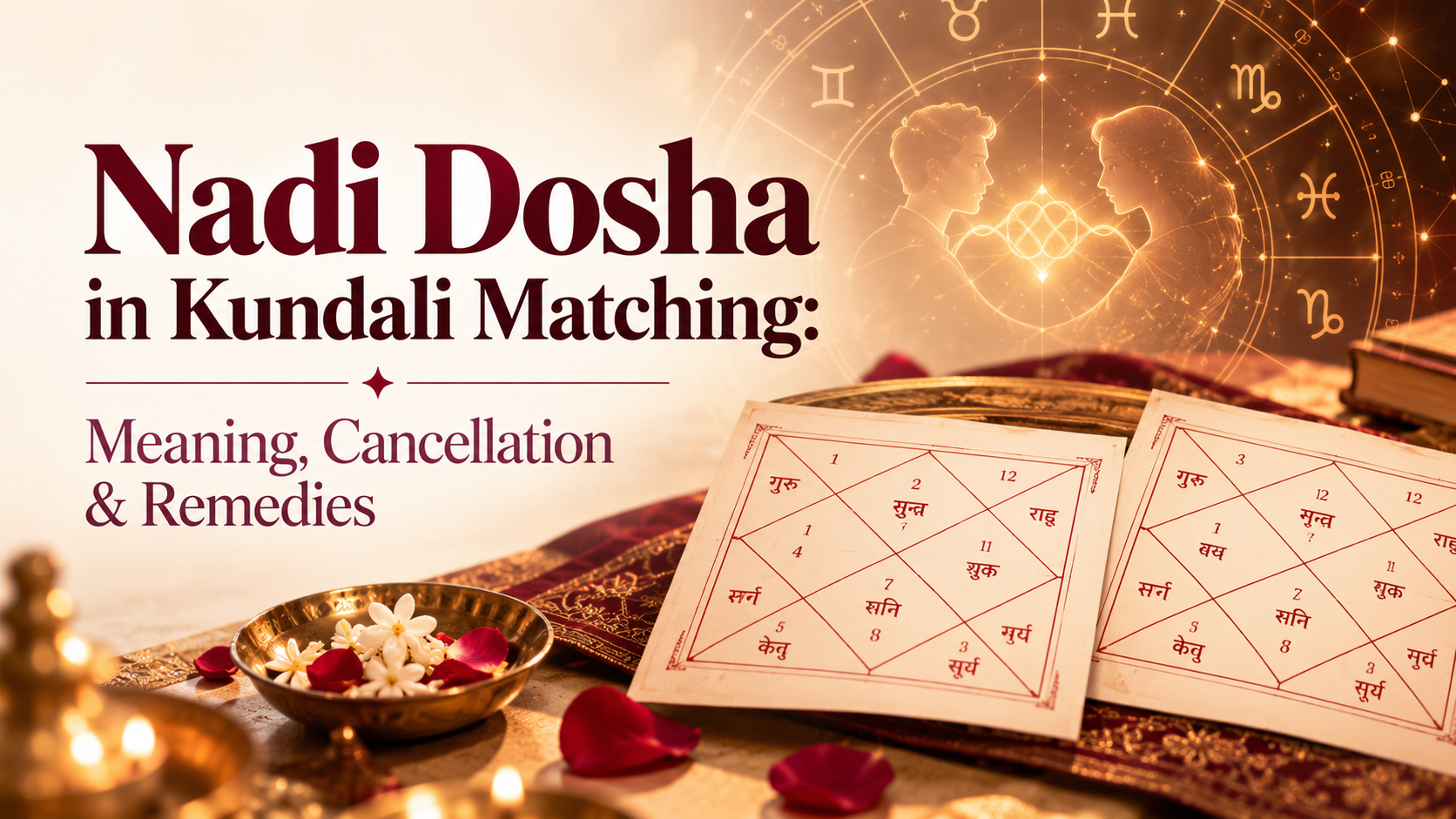
Nadi Dosha is one of the most feared results in Kundali matching, and also one of the most misunderstood. When two horoscopes are compared for marriage, the Nadi koota carries the highest score of all eight factors: 8 out of 36 points. If the bride and groom share the same Nadi, that score becomes zero, and many families start to worry.
The real picture is much calmer. Nadi Dosha is common, it has well-known cancellation rules, and it is only one part of a full chart reading. This guide explains what Nadi Dosha means, how it is worked out from the Moon's nakshatra, when it does not apply, and what you can do if it shows up in your match.
Quick answer: Nadi Dosha occurs when the bride and groom have the same Nadi (Adi, Madhya or Antya), based on their Moon nakshatras. It gives 0 out of 8 points in Guna Milan. About one in three random pairs has it, and it is often cancelled, for example when both share a Moon sign but have different nakshatras.
What Is Nadi Dosha in Kundali Matching?
In Vedic astrology, marriage matching is usually done with the Ashtakoota Guna Milan system. It compares eight factors, called kootas, using the Moon nakshatras and Moon signs of two people. Each koota has a fixed number of points, and together they add up to 36.
Here are the eight kootas, in order of their points:
- Varna – 1 point (nature and ego)
- Vashya – 2 points (mutual attraction and influence)
- Tara – 3 points (birth star harmony and well-being)
- Yoni – 4 points (physical and intimate compatibility)
- Graha Maitri – 5 points (friendship between the Moon sign lords)
- Gana – 6 points (temperament)
- Bhakoot – 7 points (emotional bond, family and finances)
- Nadi – 8 points (health, constitution and progeny)
Nadi is the last and heaviest koota. If the two people belong to different Nadis, the couple gets the full 8 points. If they belong to the same Nadi, they get 0 points, and this is called Nadi Dosha. You can see the full koota breakdown for any couple with our free Kundali Milan tool.
The Three Nadis and Their Nakshatras
The word Nadi means a channel or pulse. In Jyotish, the 27 nakshatras are divided into three Nadis, and each one is linked with one of the three Ayurvedic doshas.
Your Nadi depends only on the nakshatra your Moon was in at birth, using the sidereal zodiac. Your Sun sign and your Lagna do not change it.
| Nadi | Ayurvedic link | Nakshatras |
|---|---|---|
| Adi (Aadya) Nadi | Vata (air, movement) | Ashwini, Ardra, Punarvasu, Uttara Phalguni, Hasta, Jyeshtha, Moola, Shatabhisha, Purva Bhadrapada |
| Madhya Nadi | Pitta (fire, digestion) | Bharani, Mrigashira, Pushya, Purva Phalguni, Chitra, Anuradha, Purva Ashadha, Dhanishta, Uttara Bhadrapada |
| Antya Nadi | Kapha (water, stability) | Krittika, Rohini, Ashlesha, Magha, Swati, Vishakha, Uttara Ashadha, Shravana, Revati |
Each Nadi has exactly nine nakshatras. So any two people picked at random have about a one-in-three chance of sharing a Nadi. Nadi Dosha is not rare, and it does not mean something is wrong with either person.
Why Traditional Astrology Gives Nadi So Much Weight
Classical matching gives Nadi the most points because it was linked with the couple's physical constitution and the health of future children. The old idea is simple. Two people with the same dominant dosha, for example both Vata, may share the same strengths and the same weak spots. A mix of different Nadis was seen as more balanced for the family.
It helps to keep this in perspective. These are traditional views, not medical findings. There is no reliable scientific evidence that a same-Nadi couple will face health problems. The popular claim that "same Nadi means same blood group" is also not supported.
A good astrologer treats Nadi as one signal among many, not as a verdict on your future. For a short summary, you can also read our Nadi Dosha reference page.
Nadi Dosha Cancellation Rules
Classical texts and experienced astrologers describe several situations in which Nadi Dosha is cancelled or greatly reduced. The details vary a little between traditions, but these are the most widely accepted:
- Same Rashi, different nakshatras. If both partners have the same Moon sign but their Moons are in different nakshatras, the dosha is usually considered cancelled.
- Same nakshatra, different Rashis. Nine nakshatras are split across two signs: Krittika, Mrigashira, Punarvasu, Uttara Phalguni, Chitra, Vishakha, Uttara Ashadha, Dhanishta and Purva Bhadrapada. If both partners share one of these nakshatras but their Moons fall in different signs, the dosha is usually cancelled.
- Same nakshatra, different padas. Each nakshatra has four padas, or quarters. Many astrologers treat the dosha as cancelled when the padas are different, though some traditions are stricter about this rule.
- Same or friendly Moon sign lords. When both Moon signs are ruled by the same planet, or by planets that are natural friends, many astrologers see the dosha as much weaker.
- A strong overall match. Good Bhakoot and Graha Maitri scores, a healthy 7th house, and well-placed Venus and Jupiter in both charts can outweigh a zero in Nadi.
Because of these rules, a "0 out of 8" in Nadi does not always mean the dosha is active. Many online tools only show the raw score, so it is worth checking the cancellation factors before drawing any conclusion.
Two Simple Examples
Examples make the rules easier to follow. Both cases below use the sidereal Moon sign and nakshatra.
Example 1: Dosha present but cancelled. The bride's Moon is in Rohini, in Taurus. The groom's Moon is in Krittika pada 3, which also falls in Taurus. Rohini and Krittika are both Antya Nadi, so the raw Nadi score is 0. But both Moons are in the same Rashi and in different nakshatras. Under the first rule, the dosha is cancelled.
Example 2: Dosha that needs a closer look. The bride's Moon is in Ashwini, in Aries. The groom's Moon is in Ardra, in Gemini. Both are Adi Nadi. The Rashis are different and the nakshatras are different, so the first three rules do not apply. Mars rules Aries and Mercury rules Gemini, and these two are not natural friends. Here an astrologer would study the full charts before giving an opinion. That is a reason for care, not for fear.
Is Nadi Dosha a Deal-Breaker?
For most couples, no. Guna Milan is a quick screening method, not a complete reading. A match with Nadi Dosha can still be a good match, and a match with full Nadi points can still have challenges elsewhere in the charts.
When an astrologer reviews a same-Nadi match, they usually look at:
- Whether any of the cancellation rules apply
- The 7th house and its lord in both charts, which describe married life
- The 5th house and Jupiter, which relate to children
- Venus, the main planet of love and partnership
- The running Mahadasha and Antardasha of both people around the time of marriage
The case most astrologers take seriously is when both partners have the same nakshatra in the same pada, with no other cancellation. Even then, it is a reason to look more closely, not a final answer.
Nadi Dosha is also very different from Mangal Dosha. Nadi comes from comparing two Moon nakshatras, while Mangal Dosha comes from the position of Mars in one person's chart. If you are checking both, our guide to Mangal Dosha and its cancellations explains the second one.
Optional Remedies for Nadi Dosha
If Nadi Dosha is present and not cancelled, some families choose to do a remedy for peace of mind. Remedies are a personal choice. They are never required, and no genuine astrologer should pressure you into an expensive ritual.
Common traditional remedies include:
- Maha Mrityunjaya Mantra: chanting this Shiva mantra, or arranging a jaap, which is traditionally linked with health and protection
- Nadi Dosha Nivaran Puja: a simple puja done before marriage, usually on an auspicious day chosen from the Panchang
- Daan (charity): donating grains, clothes or food to people in need, as your means allow
- Prayer as a couple: regular worship of Lord Vishnu or Lord Shiva together, which many families find grounding
- A health check-up: a routine pre-marriage health check is sensible for any couple and gives practical reassurance
If you would like a pandit to perform a puja for you, you can explore options on our pooja booking page. A sincere prayer at home is just as meaningful.
How to check this in your own chart
You can check for Nadi Dosha yourself in a few minutes. You will need the date, time and place of birth for both people.
- Find both Moon nakshatras. Use the Nakshatra Calculator to get each person's birth star and pada.
- Find both Moon signs. The Rashi Calculator gives your sidereal Moon sign, which you need for the cancellation rules.
- Look up each Nadi. Use the table above to see whether each of you is Adi, Madhya or Antya.
- Run a full match. Enter both birth details in Kundali Milan to see the Nadi score along with the other seven kootas.
- Apply the cancellation rules. Compare your Rashis, nakshatras and padas against the rules listed earlier.
- Review the full charts. Create a free Janam Kundali for each person to see the 7th house, Venus, Jupiter and the current dasha.
The Moon moves about 13 degrees a day. If it sits near the edge of a nakshatra, even a small error in birth time can change the result, so use the most accurate time you have. If things still feel unclear, you can ask a Jyotishi a direct question about your match.
Frequently Asked Questions
Can we marry if we have Nadi Dosha?
Yes. Many couples with Nadi Dosha marry and live happy lives. Check the cancellation rules first, then look at both full charts. Nadi Dosha alone is not a reason to turn down a good match.
Is Nadi Dosha cancelled if both partners have the same Rashi?
Usually, yes, as long as the two Moons are in different nakshatras. Same Rashi with different nakshatras is one of the most widely accepted cancellation rules.
Does same Nadi mean the same blood group?
No. This is a popular belief, but there is no scientific link between Nadi and blood group. Nadi is based only on the Moon's nakshatra at the time of birth.
Does Nadi Dosha affect having children?
Traditional texts link Nadi with progeny, which is why it carries 8 points. In practice, astrologers judge children from the 5th house, its lord, Jupiter and the dasha periods. Nadi Dosha on its own does not decide this.
Are remedies necessary for Nadi Dosha?
No. Remedies are optional and are mainly done for peace of mind. If the dosha is cancelled, most astrologers say no remedy is needed at all.
Final Word on Nadi Dosha
Nadi Dosha sounds serious because it carries the most points in Guna Milan, but it is common and often cancelled. Look at your Rashis, nakshatras and padas first, then at the full charts. A calm, complete reading will tell you far more than any single score.
Disclaimer: This article shares general information from traditional Vedic astrology. It is not medical or professional advice, and astrology cannot guarantee any outcome.