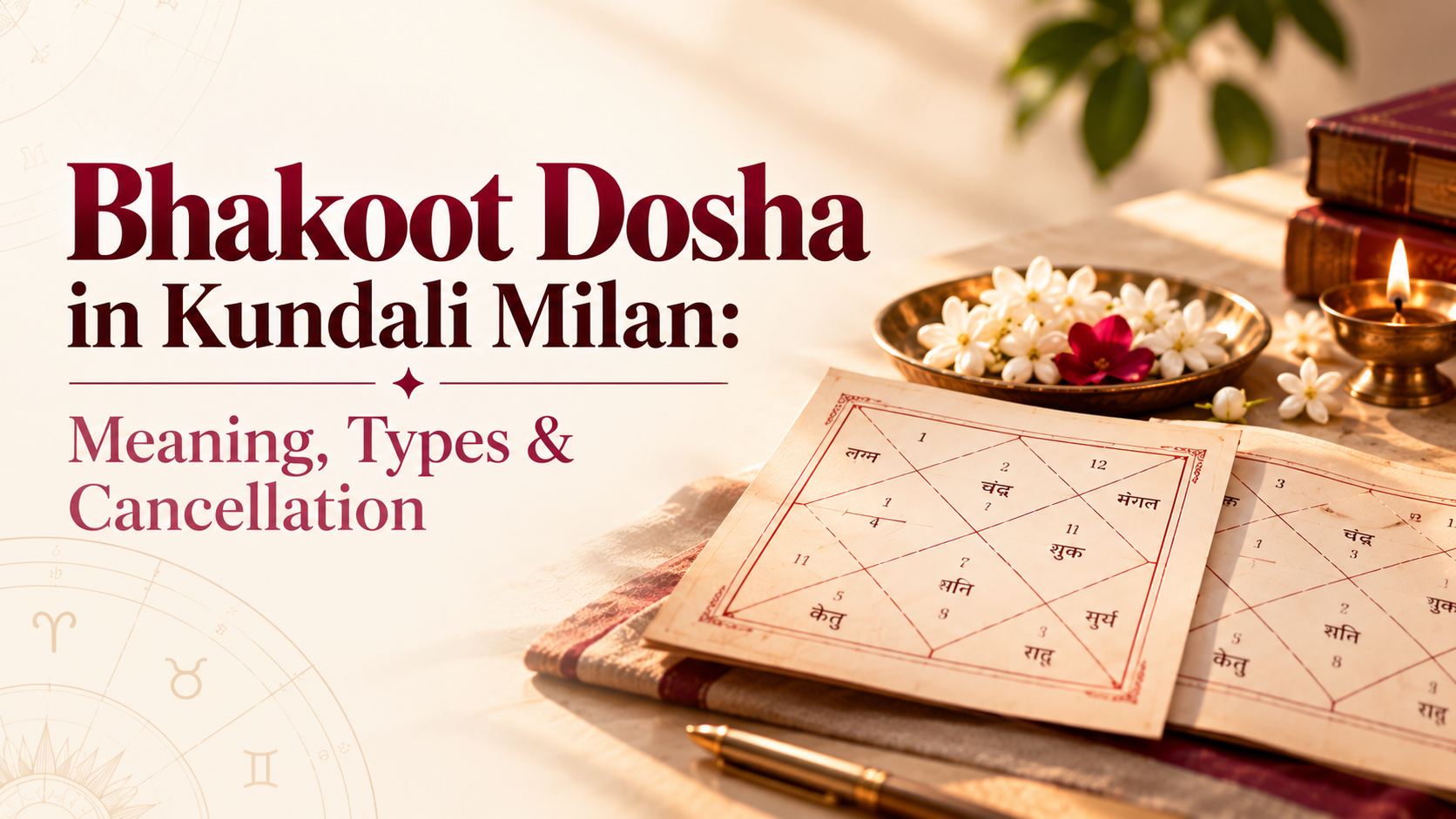
Bhakoot Dosha is one of the two big flags people notice in a Kundali Milan report, along with Nadi Dosha. Bhakoot is worth 7 of the 36 points in Guna Milan, and it looks at how the bride's and groom's Moon signs sit in relation to each other. When the pairing falls into certain patterns, the score drops to zero.
A zero can look alarming, but Bhakoot Dosha is very common and is often cancelled by simple rules. This guide covers what Bhakoot means, the three dosha patterns, the cancellation rules, and how to read your own match without worry.
Quick answer: Bhakoot Dosha occurs when the Moon signs of the bride and groom are in a 2/12, 5/9 or 6/8 position from each other. It gives 0 out of 7 points in Guna Milan. It is usually cancelled when both Moon signs share the same lord, or when the two lords are natural friends.
What Is Bhakoot in Kundali Milan?
Kundali Milan in Vedic astrology uses the Ashtakoota system. It compares eight factors between two charts and gives a total score out of 36. Bhakoot, also called Rashi Koota, is the seventh of these eight factors and carries 7 points. Only Nadi, with 8 points, carries more.
Bhakoot uses only the Moon signs (Chandra Rashi) of the two people, calculated in the sidereal zodiac. It is not based on Sun signs. You count from one person's Moon sign to the other's, and then back again. The pair of numbers you get decides the score.
Traditionally, Bhakoot is linked with the emotional bond of the couple, family growth, and shared financial well-being. You can see the Bhakoot score for any couple, along with the other seven kootas, in our free Kundali Milan tool.
How Bhakoot Points Are Calculated
Start from the bride's Moon sign and count forward to the groom's Moon sign, including both signs. Then count from the groom's sign back to the bride's. The two numbers always add up to 14, or both are 1 when the signs are the same.
Here is how each combination scores, using Aries as the starting sign:
| Moon sign position | Example pair | Bhakoot points | Traditional theme |
|---|---|---|---|
| 1/1 (same sign) | Aries – Aries | 7 | Shared outlook |
| 1/7 (Samsaptak) | Aries – Libra | 7 | Attraction and balance |
| 3/11 | Aries – Gemini | 7 | Cooperation and gains |
| 4/10 | Aries – Cancer | 7 | Home and duty |
| 2/12 (Dwi-Dwadash) | Aries – Taurus | 0 | Money and spending |
| 5/9 (Nava-Pancham) | Aries – Leo | 0 | Children and beliefs |
| 6/8 (Shadashtak) | Aries – Virgo | 0 | Health and disagreements |
Out of the twelve possible Moon sign pairings for any one person, six fall into a dosha pattern. In other words, about half of all random matches show Bhakoot Dosha before any cancellation is checked. It is a normal result, not a rare or unlucky one.
The Three Types of Bhakoot Dosha
Each dosha pattern has its own traditional meaning. These are tendencies described in classical texts, not fixed outcomes.
2/12 Bhakoot (Dwi-Dwadash)
The Moon signs are next to each other, such as Leo and Virgo. The 2nd house relates to money and family, and the 12th to expenses. Traditionally, this pairing is linked with different attitudes to saving and spending. Many couples handle it well simply by talking openly about money.
5/9 Bhakoot (Nava-Pancham)
The Moon signs are five signs apart, such as Aries and Leo. Classical matching treats this as a dosha linked with children and differences in beliefs. Interestingly, the two signs share the same element and form a trine, which is a supportive angle elsewhere in Jyotish. For this reason, many astrologers see 5/9 as the mildest of the three.
6/8 Bhakoot (Shadashtak)
The Moon signs are six signs apart in one direction and eight in the other, such as Aries and Virgo. The 6th house relates to conflict and the 8th to sudden change, so this pattern is traditionally linked with arguments and health concerns. It is the one astrologers look at most carefully, but it is also often cancelled, as the next section shows.
Bhakoot Dosha Cancellation Rules
Classical texts list clear situations where Bhakoot Dosha is cancelled or much weaker. The exact wording differs slightly between traditions, but these rules are the most widely used:
- Same Moon sign lord. If both Moon signs are ruled by the same planet, the dosha is cancelled. Examples are Aries and Scorpio (both Mars), Taurus and Libra (both Venus), and Capricorn and Aquarius (both Saturn).
- Friendly Moon sign lords. If the lords of the two Moon signs are natural friends, the dosha is usually treated as cancelled. This also shows up as a good Graha Maitri score.
- Same or friendly Navamsa lords. Some astrologers also check the signs the two Moons occupy in the Navamsa (D9) chart. If those lords are the same or friendly, the dosha is reduced.
- Strong overall agreement. When Nadi gets full points, Graha Maitri is good, and both charts show a healthy 7th house, Venus and Jupiter, a Bhakoot zero carries much less weight.
Because the first two rules are so common, a raw "0 out of 7" often turns out to be a cancelled dosha. Always check the Moon sign lords before reading too much into the number.
Bhakoot Dosha Examples
Example 1: Dosha cancelled. The bride's Moon is in Aries and the groom's Moon is in Scorpio. Counting from Aries to Scorpio gives 8, and from Scorpio back to Aries gives 6. That is a 6/8 pattern, so the raw score is 0. But Mars rules both signs, so the first rule cancels the dosha.
Example 2: Dosha cancelled by friendship. The bride's Moon is in Leo and the groom's Moon is in Pisces. This is also 6/8. Leo is ruled by the Sun and Pisces by Jupiter, and these two planets are natural friends. Most astrologers treat this dosha as cancelled.
Example 3: Needs a closer look. The bride's Moon is in Taurus and the groom's Moon is in Sagittarius, another 6/8 pair. Venus rules Taurus and Jupiter rules Sagittarius, and these two are not natural friends. Here an astrologer would check the Navamsa and both full charts before giving an opinion. This calls for care, not fear.
Is Bhakoot Dosha a Deal-Breaker?
In most cases, no. Guna Milan is a quick first filter. It does not replace a full reading of both horoscopes. Many couples with Bhakoot Dosha have stable, happy marriages, especially when the dosha is cancelled.
When an astrologer reviews a match with Bhakoot Dosha, they usually check:
- Whether the Moon sign lords are the same or friendly
- The 7th house and its lord in both charts
- The placement and strength of Venus and Jupiter
- The 2nd and 5th houses, for family, money and children
- The Mahadasha periods running for both people after marriage
It also helps to look at Bhakoot together with Nadi. These two kootas carry 15 of the 36 points between them, so a zero in both can make the total score look low even when the rest of the match is strong. Our guide to Nadi Dosha and its cancellation rules explains the other half of this picture. For an overview of other doshas checked in matching, see our doshas guide.
Optional Remedies and Practical Steps
If Bhakoot Dosha is present and not cancelled, some families choose a remedy for peace of mind. Remedies are a personal choice and are never required. A sincere effort matters more than an expensive ritual.
Traditional options include:
- Chanting the mantra of each partner's Moon sign lord, or of the Moon itself, on Mondays
- Worship of Shiva and Parvati together, often as Uma Maheshwar or Gauri Shankar puja, for harmony in marriage
- Maha Mrityunjaya Mantra, especially for the 6/8 pattern, which is traditionally linked with health
- Charity suited to the Moon, such as donating rice, milk or white clothes, as your means allow
If you would like a pandit to perform a puja for you, you can explore options on our pooja booking page.
The practical side matters just as much. For a 2/12 pair, agree early on how you will save and spend. For 5/9, talk about family plans and values. For 6/8, learn to disagree kindly and give each other space. These habits help any couple, dosha or not.
How to check this in your own chart
You can check for Bhakoot Dosha in a few minutes. You need the date, time and place of birth for both people.
- Find both Moon signs. Use the Rashi Calculator to get each person's sidereal Moon sign.
- Count the signs. Count from the bride's Moon sign to the groom's, and then back. Note whether you get 2/12, 5/9 or 6/8.
- Check the lords. Note the ruling planet of each Moon sign and see whether they are the same planet or natural friends.
- Run a full match. Enter both birth details in Kundali Milan to see the Bhakoot, Nadi and Graha Maitri scores side by side.
- Review both charts. Create a free Janam Kundali for each person to look at the 7th house, Venus, Jupiter and the Navamsa.
If the Moon was near the end of a sign at birth, a small error in birth time can change the Moon sign, so use the most accurate time you have. If you still have questions, you can ask a Jyotishi about your specific match.
Frequently Asked Questions
Can we marry if we have Bhakoot Dosha?
Yes. Bhakoot Dosha is very common, and it is often cancelled. Check the Moon sign lords first, then look at both full charts. On its own, it is not a reason to reject a good match.
Is Bhakoot Dosha cancelled if both Moon signs have the same lord?
Yes. This is the most widely accepted cancellation rule. Aries with Scorpio, Taurus with Libra, and Capricorn with Aquarius are the common examples.
Which Bhakoot Dosha is the most serious?
Traditionally, 6/8 (Shadashtak) gets the most attention, and many astrologers see 5/9 as the mildest. Even 6/8 is often cancelled by friendly or shared Moon sign lords.
Is Bhakoot Dosha the same as Nadi Dosha?
No. Bhakoot compares the two Moon signs, while Nadi compares the two Moon nakshatras. A couple can have one, both or neither.
Are remedies necessary for Bhakoot Dosha?
No. Remedies are optional and are mainly done for peace of mind. If the dosha is cancelled, most astrologers say no remedy is needed.
Final Word on Bhakoot Dosha
Bhakoot Dosha shows up in about half of all matches, so seeing it in your report is normal. Check the Moon sign lords, look at Nadi and Graha Maitri together, and then read both charts in full. That calm, complete view will tell you much more than a single zero.
Disclaimer: This article shares general information from traditional Vedic astrology. It is not medical, financial or professional advice, and astrology cannot guarantee any outcome.