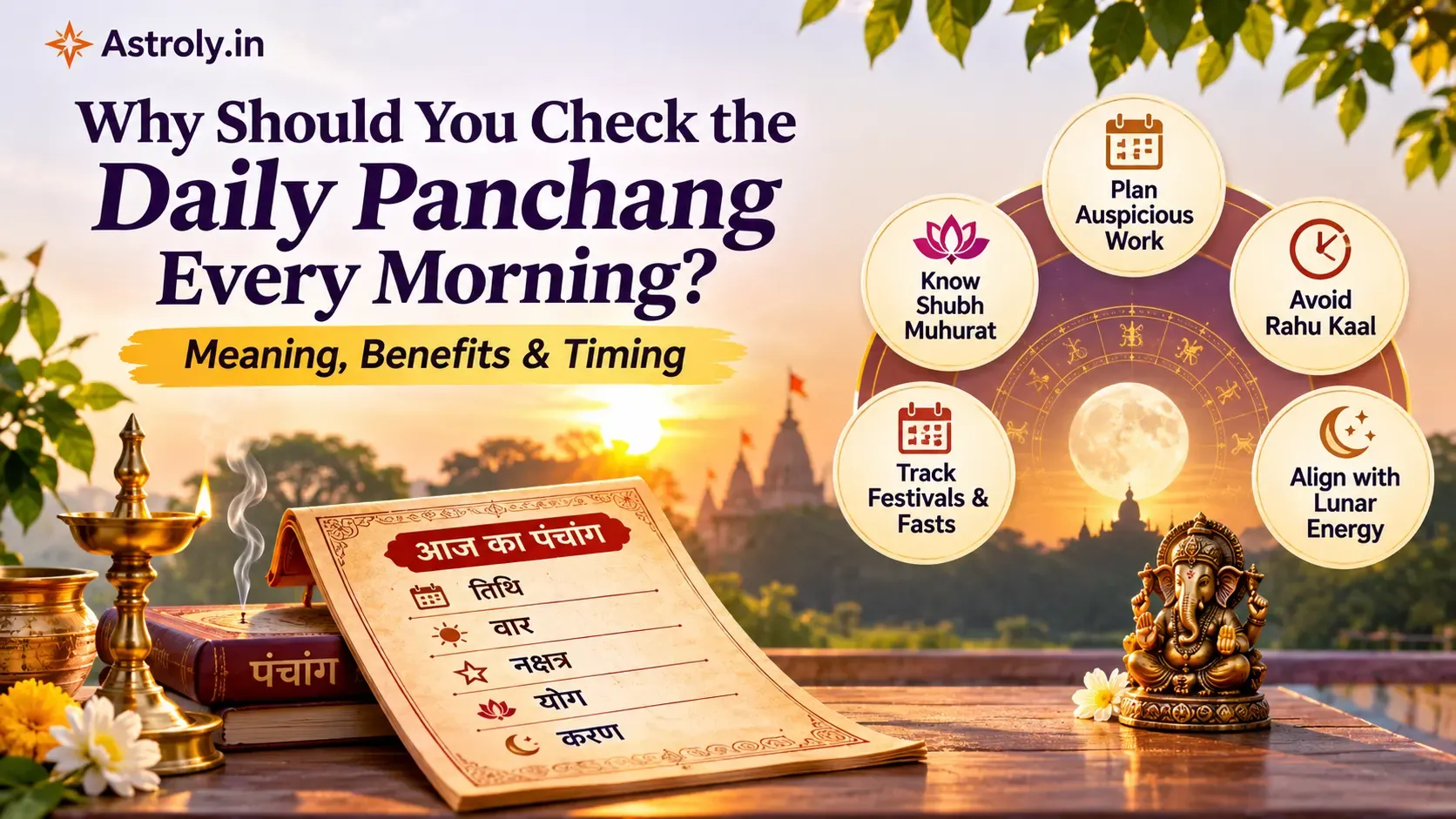
Why Should You Check the Daily Panchang Every Morning? Meaning, Benefits & Timing
Have you ever wondered why some people check the Panchang before starting their day, planning a journey or organising an important ceremony? In Vedic tradition, the Panchang is more than a calendar. It is a way of understanding the qualities of time through five important elements: Tithi, Vara, Nakshatra, Yoga and Karana.
Whether you're planning a religious ceremony, observing a fast or simply learning about Vedic astrology, understanding the daily Panchang can help you stay connected with traditional Hindu calendar practices.
But what exactly does a Panchang tell you, and why do people check it every morning? Let's understand its five elements, their significance and how you can use a daily Panchang in everyday life.
What Is a Panchang in Vedic Astrology?
The word Panchang (पंचांग) comes from two Sanskrit words: Pancha, meaning five, and Anga, meaning limbs or parts.
A Panchang is a traditional Hindu almanac that describes five important elements of a particular day. These elements are calculated using the positions and movements of the Sun and Moon.
The five elements are:
- Tithi – The lunar day.
- Vara – The weekday.
- Nakshatra – The lunar mansion occupied by the Moon.
- Yoga – One of 27 combinations calculated from the positions of the Sun and Moon.
- Karana – Half of a Tithi.
Together, these five elements help people understand traditional classifications of time and identify periods considered suitable for different activities according to Vedic astrology.
You can explore the Astroly Panchang calendar to understand these elements through daily Panchang information.
The Five Elements of Panchang Explained
Each of the five Panchang elements has a different meaning and traditional significance. Let's understand them individually.
1. Tithi – Understanding the Lunar Day
Tithi refers to the lunar day, calculated using the angular distance between the Sun and Moon.
A lunar month contains 30 Tithis, divided into two Pakshas:
- Shukla Paksha – The waxing phase of the Moon.
- Krishna Paksha – The waning phase of the Moon.
Each Paksha contains 15 Tithis, from Pratipada to Purnima or Amavasya.
Some well-known Tithis include:
- Ekadashi – Traditionally associated with fasting and devotion to Lord Vishnu.
- Purnima – The full Moon day, observed through different religious practices.
- Amavasya – The new Moon day, traditionally associated with Pitru-related rituals.
- Chaturthi – An important Tithi associated with Lord Ganesha.
Why does Tithi matter?
Tithi plays an important role in determining Hindu festivals, fasting days, religious ceremonies and traditional Muhurat calculations.
For example, someone observing Ekadashi may check the Panchang to understand when the fasting day begins and ends.
2. Vara – The Seven Days of the Week
Vara refers to the weekday. In traditional Vedic astrology, each day is associated with a particular planetary ruler.
| Weekday | Planetary ruler | Sanskrit name |
|---|---|---|
| Sunday | Sun | Ravivara |
| Monday | Moon | Somavara |
| Tuesday | Mars | Mangalavara |
| Wednesday | Mercury | Budhavara |
| Thursday | Jupiter | Guruvara |
| Friday | Venus | Shukravara |
| Saturday | Saturn | Shanivara |
According to traditional Muhurat astrology, different weekdays are considered suitable for different types of activities.
For example, Thursday is traditionally associated with Jupiter and is often considered favourable for religious learning and certain auspicious ceremonies.
Vara is therefore one of the factors considered when selecting an appropriate Muhurat.
3. Nakshatra – The Moon's Position in the Zodiac
Nakshatra refers to one of the 27 lunar mansions through which the Moon travels.
The Moon completes its journey through all 27 Nakshatras approximately once every 27.3 days, spending roughly one day in each Nakshatra. The actual duration varies.
Some important Nakshatras include:
- Ashwini – Traditionally associated with beginnings and healing.
- Rohini – Associated with growth, creativity and prosperity.
- Mrigashira – Traditionally connected with exploration and searching.
- Pushya – Often considered favourable for religious and auspicious activities.
- Magha – Associated with ancestors and traditional ceremonies.
- Revati – Traditionally connected with journeys and completion.
Why is Nakshatra important?
Nakshatra is an important consideration in Vedic astrology, particularly in Muhurat selection, marriage compatibility and birth-chart interpretation.
For example, families planning a traditional wedding may consult the Nakshatra and other Panchang elements before selecting an auspicious date.
4. Yoga – Understanding the Sun-Moon Combination
Yoga is the fourth element of Panchang.
It is calculated by adding the celestial longitudes of the Sun and Moon and dividing the resulting value into 27 equal sections.
There are 27 traditional Yogas, including:
- Vishkambha
- Priti
- Ayushman
- Saubhagya
- Shobhana
- Atiganda
- Sukarma
- Dhriti
- Shoola
- Ganda
Each Yoga has its own traditional interpretation in Vedic astrology.
Some are traditionally considered favourable for specific activities, while others are approached with caution when selecting a Muhurat.
Yoga is therefore considered alongside Tithi, Vara, Nakshatra and Karana rather than being interpreted in isolation.
5. Karana – The Half-Tithi
Karana represents half of a Tithi.
Since each lunar month contains 30 Tithis, there are 60 Karana positions in a lunar month.
Seven repeating Karanas:
- Bava
- Balava
- Kaulava
- Taitila
- Gara
- Vanija
- Vishti (Bhadra)
Four fixed Karanas:
- Kimstughna
- Shakuni
- Chatushpada
- Naga
Karana is used in traditional Muhurat calculations to assess the suitability of different periods for particular activities.
Together, these five elements form the foundation of a daily Panchang.
Why Should You Check the Panchang Every Morning?
Checking the Panchang every morning is a traditional practice followed by many Hindu families.
It helps people stay aware of the day's Tithi, Nakshatra, important observances and traditionally auspicious or inauspicious time periods.
Here are some reasons people include Panchang in their daily routine.
1. To Understand Shubh Muhurat
Shubh Muhurat refers to a traditionally considered auspicious time for undertaking a particular activity.
In Vedic Muhurat astrology, several Panchang elements are considered before selecting a suitable time.
For example, someone planning to open a new shop may consult a Panchang to identify a suitable day and Muhurat.
Similarly, families may consult Muhurat before:
- Griha Pravesh (housewarming ceremony).
- Marriage ceremonies.
- Naming ceremonies.
- Starting a new business.
- Religious ceremonies.
- Purchasing a new vehicle.
It is important to understand that Muhurat selection depends on the nature of the activity and the relevant traditional rules. A favourable time is not determined by a single Panchang element alone.
2. To Know Rahu Kaal and Other Time Periods
Rahu Kaal is one of the most commonly checked elements of the daily Panchang.
According to traditional Vedic astrology, Rahu Kaal is considered an inauspicious period for beginning new or auspicious activities.
It is calculated by dividing the local daylight period into eight equal sections. The assigned section changes according to the weekday.
Its duration is approximately 90 minutes when daylight lasts 12 hours, but the exact duration changes with the length of the day.
Other time periods commonly shown in a Panchang include:
- Yamaganda Kaal.
- Gulika Kaal.
- Abhijit Muhurat.
- Brahma Muhurat.
Knowing these timings can help people plan their traditional religious and ceremonial activities.
3. To Keep Track of Festivals and Fasting Days
Many Hindu festivals and vrat dates are determined using the lunar calendar and specific Panchang conditions.
For example:
- Ekadashi is observed on the eleventh Tithi of each Paksha.
- Purnima occurs on the full Moon Tithi.
- Amavasya occurs on the new Moon Tithi.
- Pradosh Vrat is associated with Trayodashi Tithi and evening observance.
- Chaturthi is associated with Lord Ganesha.
Checking the daily Panchang helps families stay informed about upcoming festivals, fasting days and religious observances.
It can also help people prepare for important rituals in advance.
4. To Understand the Significance of Nakshatra
Nakshatra is another important part of traditional Panchang interpretation.
The Moon moves through the 27 Nakshatras, and each Nakshatra has its own characteristics and traditional associations.
For example, Rohini is traditionally associated with growth and creativity, while Pushya is often considered favourable for certain religious and auspicious activities.
Checking the daily Nakshatra helps people understand which lunar mansion is active at a particular time.
5. To Stay Connected With Traditional Practices
For many families, checking the Panchang is not just about selecting an auspicious time.
It is also a way of maintaining a connection with cultural traditions.
Whether it is observing Ekadashi, remembering Amavasya, preparing for a festival or planning a family ceremony, the Panchang provides a structured way to follow the Hindu calendar.
Why Does Panchang Timing Change From City to City?
Have you ever noticed that Rahu Kaal or Shubh Muhurat timings may differ between Delhi, Mumbai, Bengaluru and Chennai?
This happens because many Panchang timings depend on local astronomical conditions, particularly sunrise and sunset.
The Earth rotates continuously, so sunrise and sunset occur at different times across geographical locations.
For example, the sunrise in Delhi may differ from the sunrise in Mumbai. Since several traditional time periods are calculated using the local daylight duration, their timings can also vary.
This is why using a location-specific Panchang is important.
A Panchang calculated for Delhi may not give the exact same timings as one calculated for Chennai.
Astroly provides location-specific Panchang information so users can check the timings relevant to their selected city.
For example, you can check the daily Panchang for Delhi to explore Tithi, Nakshatra, Rahu Kaal and other daily timings.
You can also use the Astroly Panchang calendar to explore different dates and Panchang details.
Rahu Kaal, Brahma Muhurat and Abhijit Muhurat: What Is the Difference?
While checking the daily Panchang, you may come across several time periods.
Three commonly discussed periods are Rahu Kaal, Brahma Muhurat and Abhijit Muhurat.
| Time period | Traditional significance |
|---|---|
| Rahu Kaal | Generally avoided for beginning new auspicious activities |
| Brahma Muhurat | Traditionally associated with meditation, prayer and spiritual learning |
| Abhijit Muhurat | Traditionally considered favourable for many auspicious beginnings |
What Is Brahma Muhurat?
Brahma Muhurat is a traditional pre-sunrise period associated with spiritual activities, meditation, prayer and study.
It is generally calculated as the 48-minute period beginning approximately 1 hour and 36 minutes before sunrise.
What Is Abhijit Muhurat?
Abhijit Muhurat is a traditionally auspicious period around local solar noon.
It generally lasts approximately 48 minutes, although the precise calculation depends on the relevant Panchang convention and local solar timings.
What Is Rahu Kaal?
Rahu Kaal is a period traditionally avoided for starting new auspicious activities.
Its timing changes every weekday and depends on the local sunrise and sunset.
These time periods should be understood within their traditional astrological context. Their interpretation can vary according to regional practices and Muhurat traditions.
How to Read a Daily Panchang: A Simple Example
If you are checking a Panchang for the first time, the information may look complicated.
But once you understand the five elements, reading it becomes much easier.
Imagine opening a daily Panchang and finding the following details:
| Panchang element | Example information |
|---|---|
| Tithi | Ekadashi |
| Vara | Thursday |
| Nakshatra | Rohini |
| Yoga | Shubha |
| Karana | Bava |
| Rahu Kaal | Local calculated timing |
| Sunrise | Local sunrise |
| Sunset | Local sunset |
This information tells you the traditional calendar details for that particular day.
You can then understand the Tithi, identify the Nakshatra, check the relevant time periods and look for festival or fasting information.
Note: This is an illustrative example, not today's actual Panchang. Actual details change every day and should be checked for your location.
Daily Panchang vs Personal Horoscope: What Is the Difference?
Many people confuse a daily Panchang with a daily horoscope. Although both are related to Vedic astrology, they serve different purposes.
| Daily Panchang | Personal Horoscope |
|---|---|
| Based on the day's astronomical positions | Based on individual birth details |
| Shows Tithi, Vara, Nakshatra, Yoga and Karana | Interprets planetary placements in a birth chart |
| Used for understanding traditional time classifications | Used for individual astrological interpretation |
| Relevant to a particular date and location | Personal to an individual's birth chart |
For example, a Panchang tells you the Tithi and Nakshatra for a particular day.
A personal horoscope interprets planetary positions in relation to your birth chart.
How to Check Today's Panchang Online With Astroly
You don't need to search through a printed almanac every morning to understand the daily Panchang.
Astroly provides an online Panchang calendar where you can explore important daily details.
Here is how to use it:
- Visit the Astroly Panchang calendar.
- Select the date you want to explore.
- Check the day's Tithi and Nakshatra.
- Understand the Yoga, Karana and Vara.
- Review Rahu Kaal and other traditional time periods.
- Check sunrise and sunset information for the relevant location.
If you want location-specific information, you can also explore the Panchang for Delhi.
The timings are useful for understanding the traditional calendar, planning observances and learning about daily Muhurat periods.
Frequently Asked Questions About Daily Panchang
1. What is a Panchang in simple words?
A Panchang is a traditional Hindu almanac that explains five important elements of a day: Tithi, Vara, Nakshatra, Yoga and Karana. It is used in Vedic astrology to understand traditional time classifications, festivals and auspicious periods.
2. Why should we check the Panchang every day?
People traditionally check the daily Panchang to understand the day's Tithi, Nakshatra, festival dates, fasting observances and auspicious or inauspicious time periods.
3. What are the five elements of Panchang?
The five elements are Tithi (lunar day), Vara (weekday), Nakshatra (lunar mansion), Yoga (Sun-Moon combination) and Karana (half of a Tithi).
4. What is the difference between Tithi and Nakshatra?
Tithi is calculated using the angular distance between the Sun and Moon, while Nakshatra refers to the lunar mansion occupied by the Moon. Both are important elements of traditional Panchang calculations.
5. What is Rahu Kaal in a daily Panchang?
Rahu Kaal is a period traditionally considered unsuitable for beginning new auspicious activities. It is calculated using the local daylight period and changes according to the weekday.
6. Why does Rahu Kaal timing differ between cities?
Rahu Kaal depends on local sunrise and sunset. Since daylight duration varies across geographical locations, the calculated Rahu Kaal timing can also differ between cities.
7. What is the difference between Brahma Muhurat and Abhijit Muhurat?
Brahma Muhurat is a pre-sunrise period traditionally associated with meditation and spiritual activities. Abhijit Muhurat is a period around local solar noon traditionally considered favourable for many auspicious beginnings.
8. Can I check today's Panchang online for free?
You can use the Astroly online Panchang calendar to explore daily Tithi, Nakshatra, Yoga, Karana, Rahu Kaal and other Panchang details. Check the website for current access and availability.
9. Is the Panchang the same for every city in India?
The underlying astronomical positions are shared, but many Panchang timings depend on local sunrise, sunset and location. Therefore, timings can differ between cities.
10. What is the difference between a Panchang and a Hindu calendar?
A Hindu calendar provides dates, months, festivals and other calendar information. A Panchang gives more detailed daily astronomical and traditional astrological information through its five elements.
Conclusion: Make the Daily Panchang Part of Your Morning Routine
The Panchang has been an important part of traditional Indian life for generations. From understanding Tithi and Nakshatra to observing fasting days and selecting traditional Muhurat, it provides a structured way to understand the Hindu calendar.
You don't need to be an expert in Vedic astrology to understand its five elements. Start with the daily Tithi, check the Nakshatra, understand the important time periods and gradually become familiar with the traditional calendar.
If you want to explore these details, visit the Astroly Daily Panchang calendar and check the information for your preferred date and location.
Start your morning with a better understanding of the day through Astroly — your companion for exploring Vedic astrology and traditional Panchang knowledge.
Disclaimer: Panchang interpretations and auspicious timings described in this article are based on traditional Hindu astrology. Regional traditions and calculation methods may produce variations. These interpretations should not be treated as scientifically established predictions or guarantees of outcomes.