Bhakoot Dosha (6/8, 5/9, 2/12): When Moon Signs Clash and When Friendly Lords Cancel It
Direct answer: Bhakoot Dosha is identified in traditional Ashtakoot Kundli matching when the Moon signs of two people form certain 6/8, 5/9 or 2/12 relationships. Bhakoot Koota carries 7 out of 36 Guna points. However, some traditional Jyotish systems recognise cancellation conditions when the Moon signs are ruled by the same planet or by friendly planets. A Bhakoot Dosha result should therefore be examined alongside the ruling planets, other Kootas and complete birth charts before drawing conclusions about marriage compatibility.
When checking Kundli matching, you may see a report showing zero out of seven points for Bhakoot Koota.
This can be confusing, especially when the overall Guna score is otherwise good. The important thing to understand is that Bhakoot is based on the relationship between two Moon signs, and its interpretation does not stop at the initial score.
Let's look at the three combinations and the traditional cancellation conditions.
What Is Bhakoot Dosha in Kundli Matching?
Bhakoot Koota is one of the eight factors in the Ashtakoot Guna Milan system. It carries a maximum of seven points out of 36.
It compares the Moon signs (Rashis) of the two individuals to examine their traditional astrological compatibility.
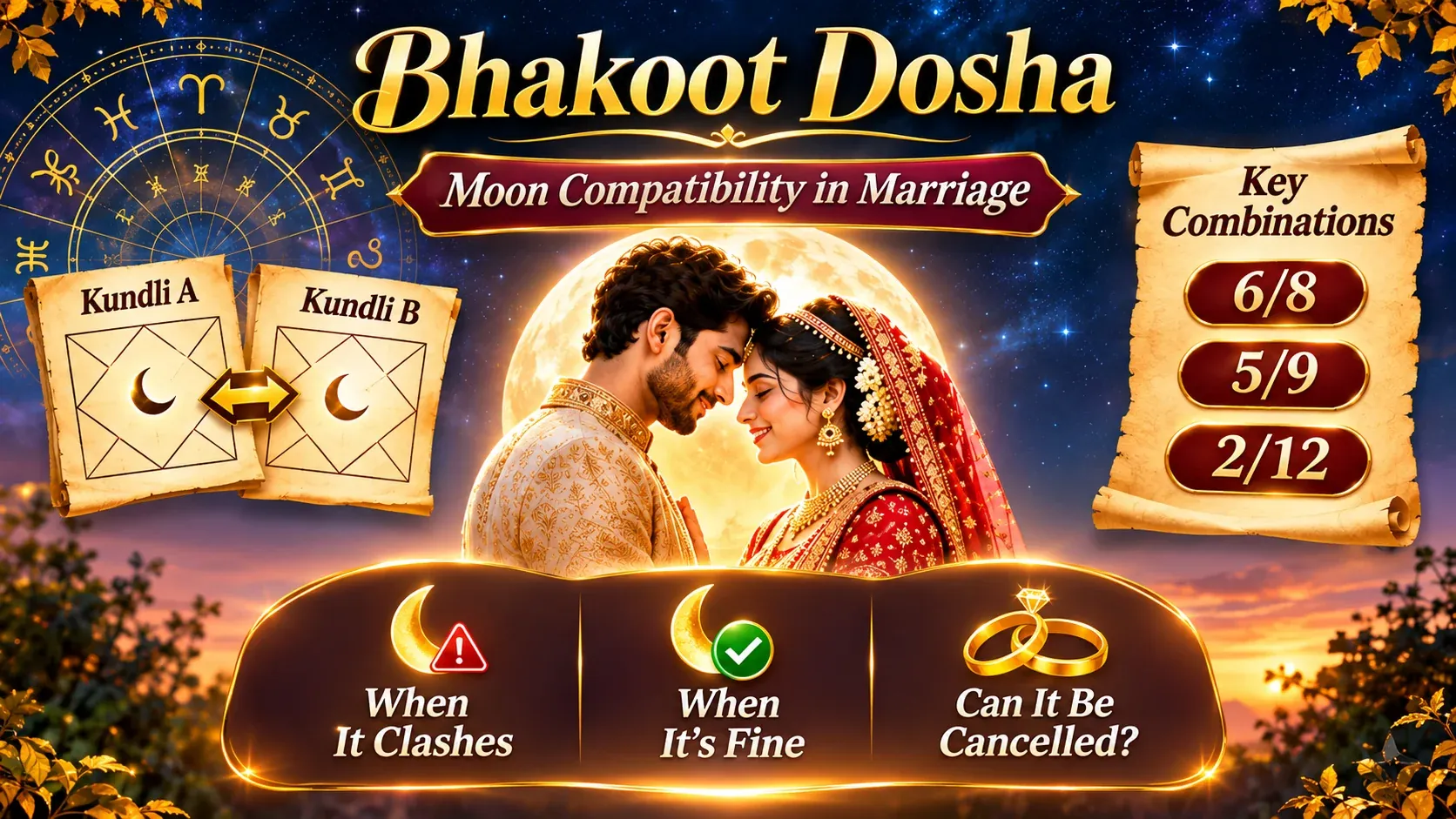
Bhakoot Dosha is commonly discussed when the Moon signs form one of these relationships:
- 6/8 — Shadashtak
- 5/9 — Nav Pancham
- 2/12 — Dwi-Dwadash
These combinations are traditionally considered challenging in certain matching systems. However, the ruling planets of the signs and other chart factors may influence the interpretation.
1. What Is 6/8 Bhakoot Dosha (Shadashtak)?
The 6/8 relationship occurs when one person's Moon sign is sixth from the other's, while the second person's sign is eighth from the first.
This is known as Shadashtak Bhakoot.
In traditional astrology, this relationship is associated with differences in temperament, priorities and ways of handling situations.
For example, Aries and Virgo form a 6/8 relationship when counted from one sign to the other.
Astrologers may examine the ruling planets of both signs, their friendship and other compatibility factors before interpreting this combination.
2. What Is 5/9 Bhakoot Dosha (Nav Pancham)?
The 5/9 relationship occurs when one Moon sign is fifth from the other and the reverse count is ninth.
It is called Nav Pancham Bhakoot.
Some traditional interpretations associate this combination with differences in outlook, beliefs, expectations or life direction.
For example, Aries and Leo form a 5/9 relationship.
The relationship between their ruling planets is also considered during interpretation. A 5/9 combination should not automatically be treated as a sign of an unsuccessful marriage.
3. What Is 2/12 Bhakoot Dosha (Dwi-Dwadash)?
The 2/12 relationship occurs when one Moon sign is second from the other, with the reverse count being twelfth.
It is known as Dwi-Dwadash Bhakoot.
Traditional interpretations may associate this combination with differences in financial priorities, lifestyle, expenses or personal expectations.
For example, Aries and Pisces form a 2/12 relationship.
The sign lords and the overall birth charts should be examined before reaching a conclusion.
When Does Bhakoot Dosha Get Cancelled?
One important part of traditional Bhakoot analysis is the relationship between the ruling planets of the two Moon signs.
Some Jyotish traditions recognise cancellation when:
1. Both Moon Signs Have the Same Ruling Planet
If the two Moon signs are ruled by the same planet, some traditional systems consider Bhakoot Dosha cancelled.
Examples include:
- Aries and Scorpio — both ruled by Mars.
- Taurus and Libra — both ruled by Venus.
- Gemini and Virgo — both ruled by Mercury.
- Capricorn and Aquarius — both ruled by Saturn.
These examples illustrate the same-ruler principle. The full chart and the specific matching tradition should still be considered.
2. The Moon-Sign Lords Are Natural Friends
Some traditional interpretations consider Bhakoot Dosha cancelled or reduced when the ruling planets of the two Moon signs are natural friends.
For example, astrologers may examine the relationship between Mars and Jupiter or the Sun and Moon when assessing the relevant signs.
The exact rule and its application can vary between schools of Jyotish. It is important to identify which planetary friendship system is being used.
3. The Complete Kundli Provides Additional Context
A broader marriage analysis may examine:
- The 7th house and its lord in both charts.
- Venus and Jupiter placements.
- The Navamsa (D9) chart.
- Other Ashtakoot results, including Nadi and Graha Maitri.
- Relevant planetary aspects and conjunctions.
These factors provide additional context. They should not automatically be described as technical cancellation of Bhakoot Dosha.
Does Bhakoot Dosha Mean a Marriage Will Fail?
No. A Bhakoot Dosha result is not a guarantee of separation, conflict or an unhappy marriage.
The 7-point Bhakoot score is only one part of the 36-point Ashtakoot system. It does not measure communication, mutual respect, emotional maturity or shared life goals.
Even within traditional astrology, the sign lords and complete birth charts are considered before reaching a conclusion.
A matching report should help people understand the traditional compatibility factors, not create unnecessary fear.
Bhakoot Dosha vs Nadi Dosha: What Is the Difference?
Both are part of Ashtakoot Guna Milan, but they examine different factors.
| Bhakoot Koota | Nadi Koota |
|---|---|
| Carries 7 points | Carries 8 points |
| Based on the relationship between Moon signs | Based on the birth Nakshatras |
| Examines 6/8, 5/9 and 2/12 relationships | Examines Adi, Madhya and Antya Nadi |
| Considers the relationship between sign lords in traditional interpretation | Considers Nakshatra-based Nadi matching and applicable exceptions |
If your report also shows Nadi Dosha, read our guide on Nadi Dosha and its traditional cancellation rules.
How to Check Bhakoot Dosha in Your Kundli Matching Report
You need the birth details of both individuals:
- Date of birth.
- Accurate time of birth.
- Place of birth.
Then follow these steps:
- Open Astroly's Kundli Matching tool.
- Enter the birth details of both individuals.
- Generate the matching report.
- Review the Bhakoot Koota score.
- Check the Moon signs and their ruling planets.
- Review any cancellation information and other compatibility factors.
Do not rely only on the final score. The relationship between the two Moon signs is important when understanding the result.
Want to Understand Your Bhakoot Dosha Result?
A Bhakoot Dosha result needs to be interpreted in context. The 6/8, 5/9 and 2/12 relationships are starting points for traditional analysis, not final judgements about a couple.
You can use Astroly's Kundli Matching tool to compare two birth charts.
If you are unsure whether a cancellation condition applies, you can chat with an astrologer on Astroly and discuss the Moon signs, ruling planets and other matching factors.
Frequently Asked Questions
1. How many points does Bhakoot Koota carry?
Bhakoot Koota carries 7 points out of the total 36 points in the traditional Ashtakoot Guna Milan system.
2. Which Moon-sign combinations create Bhakoot Dosha?
The three commonly discussed combinations are 6/8 (Shadashtak), 5/9 (Nav Pancham) and 2/12 (Dwi-Dwadash).
3. Can Bhakoot Dosha be cancelled?
Some traditional Jyotish systems recognise cancellation when the Moon-sign lords are the same or are natural friends. The applicable rules can vary by tradition.
4. Is 6/8 Bhakoot Dosha worse than 5/9 or 2/12?
All three are treated as challenging combinations in certain traditional matching systems. Their interpretation depends on the ruling planets and complete charts. There is no universal rule that one combination guarantees a worse marriage outcome.
5. Does Bhakoot Dosha affect married life?
Traditional astrology associates Bhakoot with compatibility themes, but a Bhakoot score cannot reliably predict how a marriage will develop. Real relationships depend on the people involved and their choices.
6. Is Bhakoot Dosha the same as Nadi Dosha?
No. Bhakoot compares Moon signs, while Nadi compares the birth Nakshatras of both individuals. They are separate factors in Ashtakoot matching.
Final Thoughts
Bhakoot Dosha is an important part of traditional Kundli matching, particularly when the Moon signs form 6/8, 5/9 or 2/12 relationships.
But the initial score is not the complete interpretation. The ruling planets, their relationship and the broader birth charts should also be examined.
Before rejecting a marriage match because of Bhakoot Dosha, understand the actual combination and the traditional cancellation rules that may apply.
Disclaimer: This article explains traditional Vedic astrology concepts for educational purposes. Bhakoot cancellation rules and their interpretation vary across Jyotish traditions. Astrology is not a scientifically established method of predicting marital compatibility or relationship outcomes.