Dev Uthani Ekadashi 2026: November 20 or 21? Tithi, Parana Time and Significance
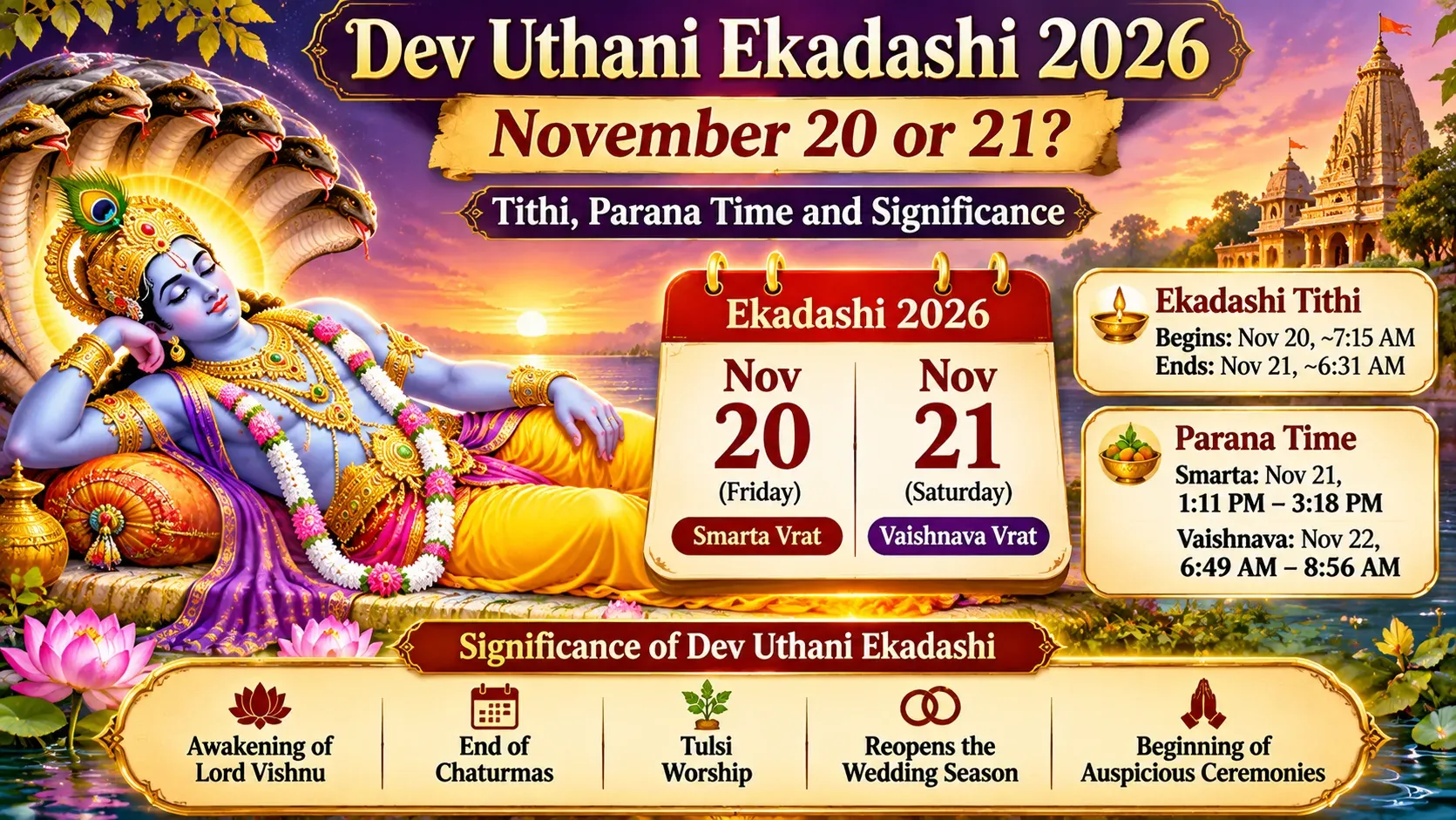
Direct answer: Dev Uthani Ekadashi 2026 falls on Friday, November 20, according to the Smarta tradition, while many Vaishnava devotees will observe the fast on Saturday, November 21. For New Delhi, the Ekadashi Tithi begins at approximately 7:15 AM on November 20 and ends at approximately 6:31 AM on November 21. The Smarta fast's Parana is on November 21, from 1:11 PM to 3:18 PM. Vaishnava devotees observing the fast on November 21 have a separate Parana window on November 22.
Dev Uthani Ekadashi, also known as Prabodhini Ekadashi or Devutthana Ekadashi, is an important Hindu observance associated with the awakening of Lord Vishnu and the end of Chaturmas.
The two dates appearing in calendars for 2026 can be confusing. The difference comes from the rules followed by Smarta and Vaishnava traditions, not from two separate Ekadashi Tithis.
Dev Uthani Ekadashi 2026: Date and Timings
The following timings are for New Delhi, India.
| Event | Date and Time |
|---|---|
| Ekadashi Tithi begins | November 20, approximately 7:15 AM |
| Ekadashi Tithi ends | November 21, approximately 6:31 AM |
| Smarta Ekadashi Vrat | Friday, November 20 |
| Smarta Parana | November 21, 1:11 PM–3:18 PM |
| Vaishnava (Gauna) Ekadashi Vrat | Saturday, November 21 |
| Vaishnava Parana | November 22, 6:49 AM–8:56 AM |
Small timing differences can occur between Panchang calculations. Always check the timings for your own city before observing the fast.
Why Is Dev Uthani Ekadashi on November 20 and November 21?
The confusion arises because Ekadashi Tithi does not always begin and end on the same calendar date.
In 2026, the Tithi begins after sunrise on November 20 and ends before sunrise on November 21 in New Delhi.
Smarta and Vaishnava traditions follow different rules for deciding the fasting day in such situations.
- Smarta tradition: The fast is observed on Friday, November 20.
- Vaishnava tradition: The Gauna Ekadashi fast is observed on Saturday, November 21.
This is why both dates appear in Hindu calendars.
If you follow a particular temple, sampradaya or family tradition, use its prescribed fasting date rather than combining the two schedules.
What Is the Significance of Dev Uthani Ekadashi?
According to Hindu tradition, Lord Vishnu enters Yoga Nidra on Devshayani Ekadashi and awakens on Prabodhini Ekadashi.
The day marks the traditional conclusion of Chaturmas, a four-month period during which many Hindu communities avoid certain auspicious ceremonies.
Dev Uthani Ekadashi is therefore associated with:
- Worship of Lord Vishnu.
- Observing Ekadashi Vrat.
- Tulsi worship.
- The traditional reopening of the Hindu wedding season.
- Beginning auspicious ceremonies in communities that follow these customs.
Devotees may observe the day through prayers, fasting, devotional songs and Vishnu worship.
When Is Ekadashi Parana in 2026?
Parana means breaking the Ekadashi fast. It is generally performed on the following Dwadashi Tithi after sunrise and after Hari Vasara has ended.
For the Smarta fast observed on November 20 in New Delhi, the Parana window is November 21, from 1:11 PM to 3:18 PM.
For Vaishnava devotees observing Gauna Ekadashi on November 21, the Parana window is November 22, from 6:49 AM to 8:56 AM.
Important: Do not use the Smarta Parana time if you are following the Vaishnava fasting schedule.
You can check the Astroly Panchang for daily Tithi and other Panchang details. For Delhi-specific timings, visit Today's Delhi Panchang.
Why Does the Wedding Season Begin After Dev Uthani Ekadashi?
In many Hindu traditions, weddings and other auspicious ceremonies are avoided during Chaturmas.
Dev Uthani Ekadashi marks the traditional end of this period. After the observance, the wedding season resumes according to the available Vivah Muhurat dates.
However, not every day after Ekadashi is automatically suitable for marriage. Families generally check the Tithi, Nakshatra, planetary positions and local muhurat before finalising the wedding ceremony.
If you are planning a wedding, read our guide to all 11 auspicious Vivah Muhurat dates before Kharmas in 2026.
Couples who follow traditional compatibility practices can also explore Kundli Matching on Astroly before finalising their wedding plans.
Frequently Asked Questions
1. When is Dev Uthani Ekadashi in 2026?
The Smarta observance falls on Friday, November 20, 2026. Many Vaishnava devotees observe Gauna Ekadashi on Saturday, November 21.
2. What time does Ekadashi Tithi begin and end?
For New Delhi, Ekadashi Tithi begins at approximately 7:15 AM on November 20 and ends at approximately 6:31 AM on November 21.
3. What is the Dev Uthani Ekadashi Parana time in 2026?
For the Smarta fast, the New Delhi Parana window is November 21, from 1:11 PM to 3:18 PM. Vaishnava devotees observing the fast on November 21 have a separate Parana window on November 22.
4. Why are there two Dev Uthani Ekadashi dates?
Smarta and Vaishnava traditions follow different rules for selecting the fasting day when Ekadashi Tithi does not cover a complete sunrise-to-sunrise period.
5. Does Dev Uthani Ekadashi mark the end of Chaturmas?
Yes. Traditionally, Prabodhini Ekadashi marks the awakening of Lord Vishnu and the conclusion of Chaturmas.
6. Do weddings start immediately after Dev Uthani Ekadashi?
The traditional wedding season resumes after Chaturmas, but a suitable Vivah Muhurat must still be selected according to the local Panchang and family tradition.
Final Thoughts
Dev Uthani Ekadashi in 2026 has two observance dates because of the difference between Smarta and Vaishnava traditions.
For New Delhi, the Smarta fast is on November 20, while the Vaishnava observance is on November 21. Their Parana timings are also different.
Before observing the fast, check the schedule followed by your tradition and confirm the local Tithi and Parana window through a reliable Panchang.
Disclaimer: Dates and timings in this article are based on New Delhi Panchang calculations. They may vary by location and religious tradition. Confirm your local fasting and Parana timings before observing the Vrat.