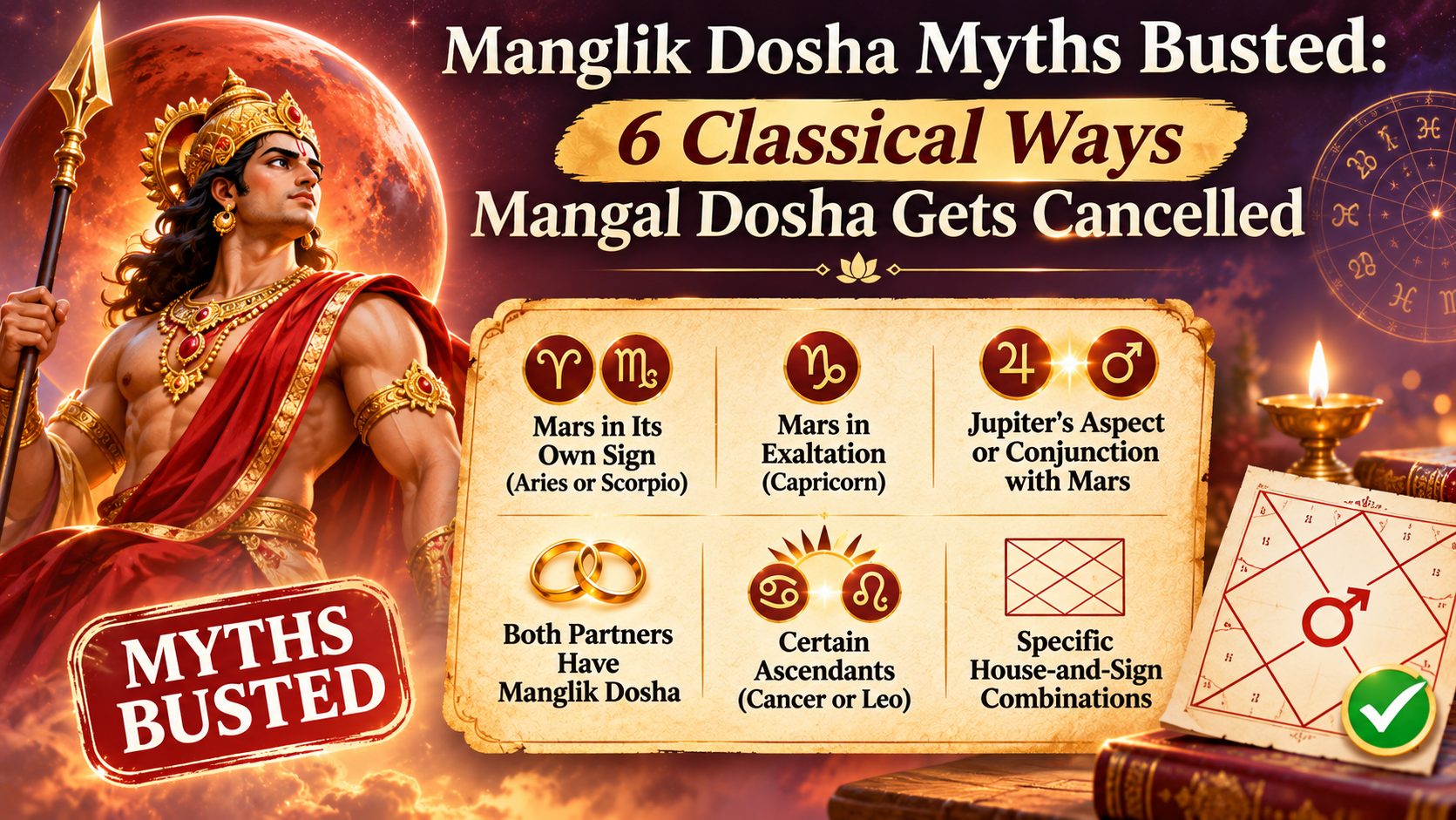
Manglik Dosha Myths Busted: 6 Classical Ways Mangal Dosha Gets Cancelled
Direct answer: Manglik Dosha is not always considered active or equally strong in every birth chart. Traditional Vedic astrology recognises several cancellation or reduction conditions, including Mars in its own sign, Mars in exaltation, Jupiter's influence on Mars, and both partners having Manglik Dosha. Certain ascendant-specific and house-sign combinations are also considered exceptions in some traditions. A proper assessment requires checking the complete Kundli rather than judging Mars's house placement alone.
The word Manglik can create unnecessary worry during marriage discussions. Sometimes a match is rejected simply because Mars appears in a particular house, without checking whether any cancellation conditions apply.
In Vedic astrology, this is an incomplete way to read a birth chart. The strength of Mars, its sign, planetary aspects and the charts of both partners can change the traditional interpretation.
Here are six commonly discussed Manglik Dosha cancellation conditions and one important myth about age.
First, Which Houses Create Manglik Dosha?
Manglik Dosha, also called Mangal Dosha or Kuja Dosha, is traditionally associated with Mars occupying certain houses of the birth chart.
A commonly used system checks Mars in the:
- 1st house
- 4th house
- 7th house
- 8th house
- 12th house
Some regional traditions also include the 2nd house. Certain astrologers additionally examine Mars from the Moon and Venus, not just the ascendant.
This difference in calculation methods is one reason why two online Manglik calculators may show different results.
You can start by checking your own placement through Astroly's Free Mangal Dosha Calculator.
6 Traditional Manglik Dosha Cancellation Conditions
1. Mars in Its Own Sign: Aries or Scorpio
Mars rules Aries (Mesha) and Scorpio (Vrishchika).
When Mars occupies either of its own signs, many traditional interpretations consider the Manglik influence reduced or cancelled, depending on the chart and the rule being followed.
The reasoning is that Mars is placed in a sign it rules and can express its planetary qualities with greater strength and control.
However, simply finding Mars in Aries or Scorpio is not enough to make a final judgement about marriage compatibility.
2. Mars in Its Exalted Sign: Capricorn
Capricorn (Makara) is the exaltation sign of Mars.
In traditional astrology, an exalted Mars is considered strong and capable of expressing its qualities in a more disciplined and organised way.
Some Manglik Dosha cancellation traditions therefore treat Mars in Capricorn as an important exception.
The house occupied by Mars, its aspects and the overall condition of the birth chart still need to be examined.
3. Jupiter's Aspect or Conjunction with Mars
Jupiter (Guru) is traditionally regarded as a benefic planet associated with wisdom, guidance and protection.
When Jupiter is in conjunction with Mars or casts its aspect on Mars, some classical interpretations consider the influence of Manglik Dosha softened.
This is why astrologers examine Jupiter's position rather than simply checking where Mars is placed.
A Jupiter aspect does not mean that every other difficulty in the birth chart disappears. Its strength, placement and relationship with other planets matter.
4. Both Partners Have Manglik Dosha
This is one of the most widely discussed rules in traditional marriage matching.
When both partners have Manglik Dosha, the traditional interpretation considers the similar Mars influence in their charts capable of balancing the dosha.
However, both charts should be examined properly. Merely seeing a Manglik label on two reports does not establish that the placements have equal strength or that the match is automatically suitable.
The rest of the compatibility analysis remains important.
5. Certain Ascendants Change the Interpretation of Mars
Mars does not have the same functional role for every ascendant.
For Cancer and Leo ascendants, Mars is traditionally considered a Yogakaraka planet because of the houses it rules.
For Cancer ascendant, Mars rules the 5th and 10th houses. For Leo ascendant, it rules the 4th and 9th houses.
Some traditional interpretations therefore treat Mars differently for these ascendants instead of applying the ordinary Manglik rule mechanically.
This is an important reason to check the ascendant and planetary lordships before declaring someone Manglik.
6. Specific House-and-Sign Combinations Can Act as Exceptions
Some traditional Jyotish and regional marriage-matching systems recognise particular house-and-sign combinations as exceptions to Manglik Dosha.
Examples commonly discussed include:
- Mars in the 2nd house in Gemini or Virgo.
- Mars in the 4th house in Aries or Scorpio.
- Mars in the 7th house in Cancer or Capricorn.
- Mars in the 8th house in Sagittarius or Pisces.
- Mars in the 12th house in Taurus or Libra.
These combinations are not applied identically by every school of astrology. Some astrologers treat them as full cancellation, while others consider them a reduction in severity.
Therefore, these rules should be checked against the specific calculation tradition being used.
Does Manglik Dosha Automatically End After Age 28?
No universal classical rule says that Manglik Dosha automatically disappears when a person turns 28.
This is a popular belief repeated in many marriage discussions, but it should not be treated as a universal cancellation principle.
Mars's birth-chart position does not change with age. What may change over time is the person's maturity, relationship experience and running planetary periods.
These are separate considerations from cancellation of the original chart placement.
Is It Necessary for Both Partners to Be Manglik?
No. Both partners do not have to be Manglik for a marriage to be considered.
Traditional matching examines whether the dosha is present, how strong it is, whether cancellation conditions apply and how the two complete charts compare.
A non-Manglik and Manglik match should not be rejected based on one label alone.
You can compare both birth charts using Astroly's Kundli Matching tool.
For a broader explanation of Manglik Dosha, its traditional effects and remedies, read our guide on Mangal Dosha effects, cancellations and remedies.
How to Check Whether Your Manglik Dosha Is Cancelled
Before reaching a conclusion, follow these steps:
- Generate your birth chart using accurate date, time and place of birth.
- Identify Mars's house and sign.
- Check which house-counting method is being used.
- Examine Mars's conjunctions and aspects, especially Jupiter's influence.
- Review the applicable cancellation conditions.
- Compare both partners' charts before making a marriage-related interpretation.
Start with the Free Mangal Dosha Calculator on Astroly. You can also generate your Free Online Kundli to review your planetary placements.
If you are unsure how a particular cancellation rule applies to your chart, you can chat with an astrologer on Astroly for a personalised traditional interpretation.
Frequently Asked Questions
1. Can Manglik Dosha be cancelled completely?
Some traditional combinations are treated as full cancellation, while others are considered to reduce its influence. The interpretation depends on the astrological school and complete birth chart.
2. Does Mars in its own sign cancel Manglik Dosha?
Mars in Aries or Scorpio is commonly listed as a cancellation or reduction condition. The final interpretation depends on the house, ascendant and other planetary influences.
3. Does Jupiter's aspect cancel Mangal Dosha?
Jupiter's aspect on Mars is a commonly recognised traditional mitigating condition. However, not every astrologer treats it as complete cancellation.
4. Does Manglik Dosha end after 28 years?
There is no universal classical rule that automatically removes Manglik Dosha at age 28. Age-related maturity and planetary periods are different from cancellation of a birth-chart placement.
5. What happens if both partners are Manglik?
Traditional marriage matching often considers the presence of Manglik Dosha in both charts a balancing condition. However, the strength of the dosha and the rest of both charts must still be examined.
6. Can a Manglik person marry a non-Manglik person?
Yes. A Manglik label alone is not a reason to reject a marriage proposal. The full compatibility analysis and applicable cancellation conditions should be considered.
Final Thoughts
Manglik Dosha should never be judged by looking at Mars's house placement alone.
Traditional Vedic astrology includes several cancellation and reduction conditions involving Mars's sign, Jupiter's influence, ascendant lordship, specific house-sign combinations and the charts of both partners.
The important thing is to understand the complete Kundli instead of making a marriage decision based on a single label.
A Manglik result is a starting point for chart analysis, not a final verdict on someone's marriage.
Disclaimer: This article explains traditional Vedic astrology interpretations for educational purposes. Different Jyotish traditions apply Manglik Dosha and its cancellation rules differently. Astrology is not a scientifically established method of predicting marriage outcomes.