
Introduction
My aunt called me on a Sunday morning in a bit of a panic. A rishta had come in for my cousin, everyone liked the boy on paper, but nobody could get an appointment with the family pandit for another two weeks. Two weeks! I told her, half-joking, just do a free Kundali Milan online. She genuinely didn't believe it would work.
It worked. Ten minutes, maybe less, and we had a full Guna Milan score, a dosha breakdown, and enough to actually talk about instead of sitting around anxious.
You've probably lived some version of this. The back-and-forth with a pandit's assistant. "Ma'am please call after 6." The waiting. A free Kundali Milan check doesn't erase tradition, and it's not meant to. It just gives you a fast, honest first read before you pour more time and feelings into something.
So here's what I actually learned digging into this — what Kundali Milan checks, why the 36-point system exists, what those doshas everyone whispers about really mean, and whether a free app can hold its own against a pandit visit. I'll keep it simple. No dense astrology-speak, I promise.
What Does Kundali Milan Actually Check?
Kundali Milan, sometimes called Guna Milan, is the traditional way of comparing two birth charts before marriage. Families have leaned on this for generations, and it's not just checking "will they get along."
It compares eight specific factors, the Gunas, based on where the Moon sat in each person's chart at the moment they were born.
The Ashtakoot System, Without the Jargon
Ashtakoot just means eight points of comparison. Each Guna carries its own weight, and stacked together they max out at 36 points total.
Higher usually means smoother compatibility on paper. Most families treat 18+ as workable, though honestly, how strict people are about that number varies a lot household to household.
Why Everyone Fixates on the Moon Sign
Western astrology obsesses over your Sun sign. Vedic matching cares more about the Moon, because your Moon sign is tied to emotional temperament. Matching two Moon signs is really just asking: will these two people's emotional wiring get along?
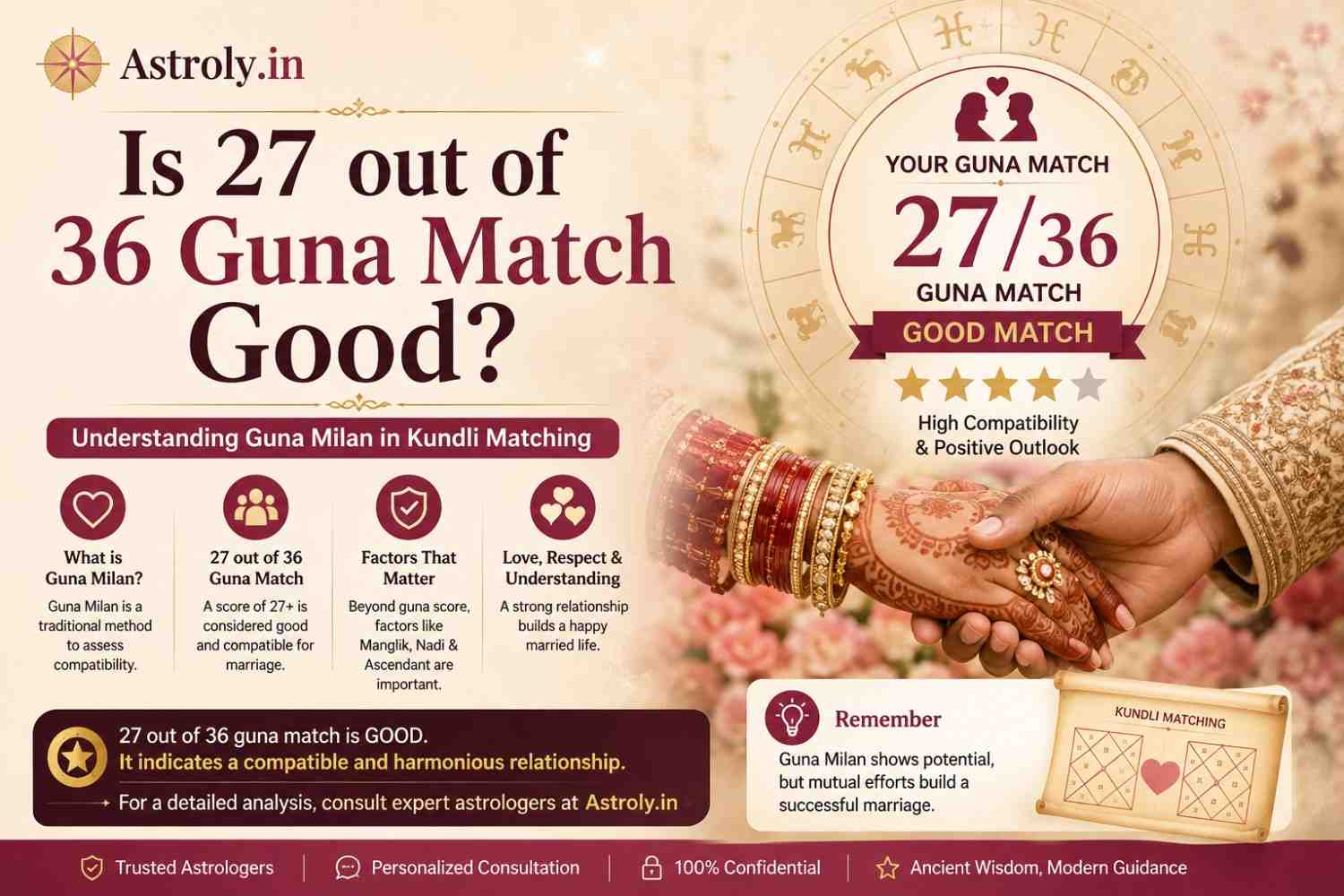
Understanding the 36 Guna Score
First time I saw "28/36" on a report, I genuinely had no clue if that was a good score or a red flag. Turns out it's less about the raw number than people think.
What Actually Counts as "Good"
18 and up is generally considered workable. Somewhere in the 24-32 range is seen as quite favorable. Getting close to a full 36 is rare, and — this surprised me — not even necessary for a good marriage.
A Low Score Isn't Automatically Game Over
Some individual Gunas just weigh more than others in the final total. And a lot of doshas have remedies attached to them. So a lower overall number doesn't have to be the end of the conversation.
The Number Isn't the Whole Story
A decent free Kundali Milan report breaks down every single Guna, not just the total at the top. That's where you actually see whether the friction (if any) is about temperament, health, or something else entirely.
Mangal Dosha and the Other Doshas People Whisper About
If you've sat through any matchmaking conversation in an Indian family, you've heard "Mangal Dosha" said in that particular worried tone.
What It Actually Means
Mangal Dosha shows up when Mars sits in certain houses of the birth chart. Traditionally, it's linked to more friction or delay in marriage if it's not matched properly between the two people.
It's Genuinely Less Scary Than It Sounds
Here's the bit nobody explains well: if both people have Mangal Dosha, it tends to cancel itself out. There are also remedies — some astrological, some just practical family traditions — that people have used forever.
Other Doshas Worth Knowing
You'll also hear Nadi Dosha and Bhakoot Dosha thrown around. Nadi is about health and genetic compatibility. Bhakoot is more emotional and financial harmony. A good report flags both clearly instead of burying them.
Free Online Kundali Milan vs. an Actual Pandit Visit
I'm not saying skip the pandit. I wouldn't say that to my own family. But let's be real about what each option gives you.
Speed, Obviously
A pandit visit means scheduling, maybe travel, sometimes a wait stretching into weeks. A free Kundali Milan report through an app? Same Ashtakoot math, done in minutes, from your couch.
The Math Doesn't Care Who's Doing It
Ashtakoot is a fixed calculation based on birth details, not intuition. If an app is using accurate astronomical data, the core score lines up with what a pandit would calculate by hand.
Where a Human Astrologer Still Wins
A pandit's real value is in nuance — reading between the lines, tailoring remedies to a specific family's worries, that kind of thing. Treat the free report as a first filter, not the final say.
How Astroly Handles This
Astroly runs the complete Ashtakoot matching using precise chart calculations, then explains it in normal language instead of dense astrological terms. Score, doshas, plain explanation, all free, right on your phone.
Getting an Accurate Free Kundali Milan Report
The report's only as good as what you feed it, so a little prep actually matters here.
Nail Down the Birth Details
You need exact birth date, time, and place for both people. Even a small mistake in birth time can shift the Moon sign and throw off the entire score.
"Around Morning" Isn't a Birth Time
If there's no birth certificate handy, dig through old family records or just ask a parent directly. Vague guesses about timing lead to a report that's, frankly, not that useful.
Actually Read the Breakdown
Don't just glance at the total and move on. The real insight sits in the individual Guna and dosha explanations, not the headline number.
Final Thoughts: Check the Match Before the Next Big Step
Back to my cousin's story — that free report didn't make the final decision for anyone. It just gave the family something concrete to talk about instead of nervous guessing while waiting for a callback.
A free Kundali Milan check is a smart first move whenever a match comes up, arranged or otherwise, before things go further. It costs nothing, takes minutes, and gives you real Ashtakoot data instead of vague reassurance from someone trying to be polite.
Want to check your own match? or and get your report in a few minutes.
Sometimes the clarity you need really is just a few taps away.
Frequently Asked Questions
Is a free Kundali Milan report actually accurate? It is, as long as the app is using correct astronomical data and precise birth details. Ashtakoot is a fixed calculation, so the math itself doesn't shift based on who's running it.
What counts as a good Guna Milan score? 18 out of 36 is traditionally the baseline for acceptable, with 24+ seen as favorable. Different families weigh this differently though, and some doshas matter more than the raw total.
Does having Mangal Dosha ruin the match? Not necessarily. If both people have it, it often cancels out. And there are traditional remedies families lean on when only one partner has it.
Do I actually need the exact birth time? Yes. Birth time shapes the Moon sign, which is the backbone of the whole matching process. A rough estimate can throw the whole report off.
Can this replace talking to a pandit? It's a solid first step, quick and free. For deeper remedy advice or a final family decision, plenty of people still want a pandit's input on top of it.
Is Astroly's Kundali Milan feature really free? Yes, the core matching is free. There are optional premium features if you want a more detailed reading later.