
Introduction
If you've ever sat through a family conversation about marriage, you've probably heard someone bring up kundali milan. It's one of those traditions that just won't fade, and honestly, there's a reason for that. A free kundali milan check is often the first real step families take before saying yes to a match. It compares two birth charts and hands out a score — out of 36 points — that's supposed to tell you how well two people will get along.
Here's the thing though: you don't need to track down a pandit or wait around for an appointment anymore. Apps like Astroly have made this whole process ridiculously quick. Type in a few birth details, and you'll have your free kundali milan report before your tea gets cold.
What actually goes into this? Planetary positions, nakshatras, doshas — it sounds complicated, and in a way it is, but the output is simple enough. It tells you where two people line up and where they might clash, on everything from temperament to health to whether the marriage looks financially stable on paper.
This article walks through what kundali milan actually means, how the Guna scoring works, and how you can run your own free kundali milan check on Astroly without any of the usual back-and-forth.
What Kundali Milan Actually Means
Kundali milan — some people call it Guna Milan or horoscope matching — comes from Vedic astrology. In short, it's a comparison of two birth charts to see if a marriage is likely to work out well.
The logic behind it is old but not complicated. Astrologers believe the position of planets at the moment you're born shapes your personality and tendencies. Put two charts side by side, and patterns start to emerge — where two people naturally sync up, and where friction might show up down the line.
Where This Tradition Comes From
This isn't something someone invented last century. It goes back to Vedic scriptures written centuries ago, when sages were trying to figure out how to steer families toward marriages that would actually last.
Why People Still Bother With It
You'd think in 2026 this practice would've faded out, but it hasn't. Families still lean on it, partly out of tradition and partly because it genuinely offers something concrete to talk about — emotional compatibility, finances, health, even the likelihood of having kids without complications. For a lot of parents, it's less about superstition and more about having one more data point before a big decision.
The 36 Guna System, Explained Simply
Most kundali matching you'll come across uses the 36 Guna method. It's the industry standard, so to speak. The system checks eight separate factors — called Ashtakoot — between the two charts, and each one carries its own points. Add them up, and the maximum possible score is 36.
The Eight Factors That Get Checked
Varna, Vashya, Tara, Yoni, Graha Maitri, Gana, Bhakoot, and Nadi — these are the eight. Each one looks at something different. Some check mental compatibility, others look at physical or sexual harmony, and a few focus specifically on the health of children the couple might have.
So What Counts as a "Good" Score?
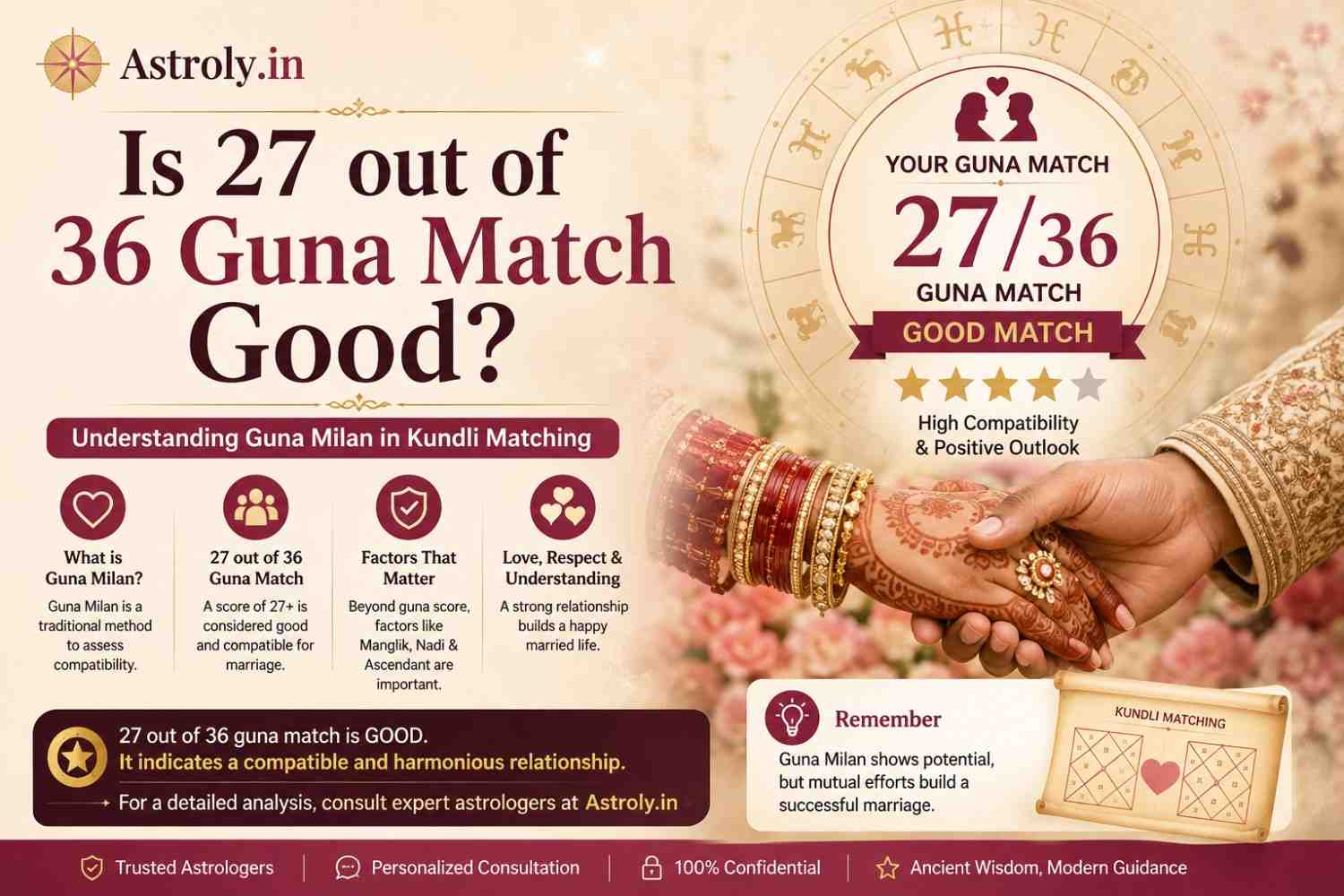
Generally, anything 18 or above out of 36 is treated as workable. Below that, it's not necessarily a dealbreaker, but most astrologers will want to dig deeper before ruling anything out completely.
Don't Forget About Manglik Dosha
Alongside the Guna score, there's also a check for Manglik Dosha — a condition tied to where Mars sits in someone's chart. If one partner is Manglik and the other isn't, that alone can shift the final read on compatibility, so it's worth paying attention to.
Why Bother With an Online Tool at All
Not too long ago, getting a kundali matched meant physically going to see someone, handing over paperwork, and waiting. Sometimes for days. And usually paying for the privilege.
That's mostly gone now. A decent online tool can spit out a free kundali milan report in the time it takes to make a cup of chai.
It's Just Faster
The calculations behind kundali matching are genuinely complex — lots of planetary math happening in the background. A good app handles all of it in seconds. You enter birth date, time, and place for both people, and that's it.
Speed Doesn't Mean Sloppy
There's a common worry that fast equals inaccurate. Not really the case here. The formulas underneath are still proper Vedic astrology — the same ones a traditional astrologer would use with pen and paper. The app just does the math faster.
And It Costs Nothing
Since it's free, there's no pressure to commit to anything. Check one match, check five — doesn't matter. You're not paying per report, so there's room to actually explore before you decide anything.
How to Actually Get Your Report
This part's straightforward. Here's how it works on Astroly.
Step 1: Add the Birth Details
You'll need full names, dates of birth, exact birth times, and birthplaces for both people. Time matters more than people expect — even a 15-minute difference can shift the result slightly, so get this part right if you can.
Step 2: Let It Run
Once you've submitted everything, the tool crunches the planetary positions and runs the 36 Guna comparison automatically. No waiting around — it's done in seconds.
Step 3: Read Through the Breakdown
You won't just get a number. You'll see how each of the eight Kootas scored individually, the total, and any doshas flagged along the way. That context matters more than the raw score by itself.
If You Want More Than Just Matching
For something more detailed, grab the . Beyond kundali matching, it covers full birth chart analysis and daily horoscopes too — useful if you're curious about more than just one compatibility check.
Clearing Up a Few Myths
There's a fair bit of misinformation floating around about kundali milan. Let's sort through the big ones.
"A Low Score Means the Marriage Is Doomed"
Not true, and it's worth saying clearly. A low Guna score points to areas that might need more effort or understanding — it's not a verdict. Plenty of marriages with modest scores do just fine because the people involved actually work at it.
"A High Score Means Smooth Sailing"
Also not quite right. A high score is a good sign, sure, but it doesn't replace communication, patience, or basic compatibility in day-to-day life. Astrology can point you in a direction; it can't do the relationship for you.
"Free Tools Must Be Cutting Corners"
This one comes up a lot. People assume free means watered-down. But platforms like Astroly run on the same underlying Vedic calculations that a paid astrologer would use — the price tag doesn't change the math.
Wrapping Up
Kundali milan isn't going anywhere as part of Indian marriage culture, and thankfully, checking it has never been this easy. A free kundali milan report through something like Astroly gives you a real, quick way to see where two people stand — no cost, no waiting room.
It's not a crystal ball. A good score doesn't guarantee happiness, and a low one doesn't guarantee failure. What it does give you is a bit more clarity before a decision that deserves careful thought.
If you're curious, head over to and run your free kundali milan report right now. Or if you'd rather have it on your phone, grab the for the fuller picture — horoscopes, chart analysis, the works.
Frequently Asked Questions
Is kundali milan actually free on Astroly, or is there a catch? It's free — no hidden charges for the basic Guna Milan report.
What information do I need to enter for an accurate match? Full name, date of birth, exact birth time, and birthplace, for both people.
What's considered a solid Guna Milan score? 18 out of 36 or higher is usually seen as acceptable, though some families set the bar differently.
Does a low score mean we shouldn't get married? No. It flags areas worth paying attention to, but plenty of couples with lower scores build strong marriages anyway.
What exactly is Manglik Dosha? It's a condition based on where Mars falls in a birth chart, and it's checked separately from the Guna score for a fuller picture.
Can the Astroly app do more than just kundali matching? Yes — it also covers horoscopes, birth chart readings, and general astrology guidance beyond just compatibility checks.