Introduction
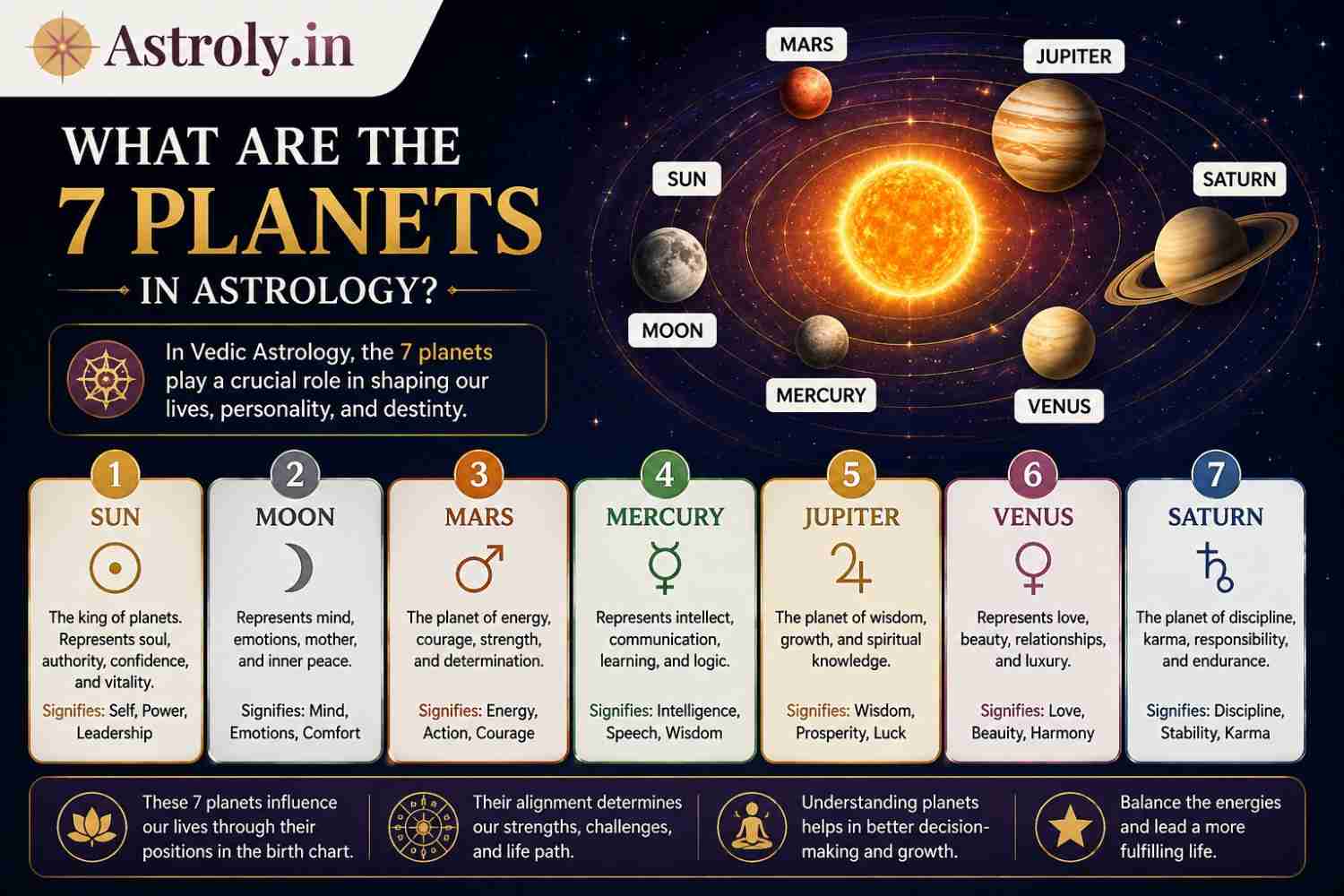
If you've started reading about your birth chart, you've probably hit this question fast: what are the 7 planets in astrology, and why do they get so much attention? They're the Sun, Moon, Mercury, Venus, Mars, Jupiter, and Saturn — and together, they're the backbone of both Western and Vedic astrology.
None of this is new. People have been mapping these seven bodies for thousands of years, long before telescopes existed. What's changed is how we access this knowledge — you no longer need an astrologer on call to make sense of it.
This guide walks through what each planet actually means, how they connect to your zodiac sign, and where Vedic and Western astrology part ways on the topic. Once you've got the basics down, you can pull up your own placements in the and see how they line up.
What "7 Planets" Actually Means in Astrology
Here's the first surprise for most beginners: astrology's seven planets aren't the planets from your science textbook. The list includes the Sun and Moon, which astronomers classify as a star and a satellite, not planets at all.
This is an old system. It comes from a time before anyone had a telescope, so early astrologers worked only with what they could see from the ground.
Astrology's Planets vs. Astronomy's Planets
Astronomy cares about mass, orbit, and composition. Astrology cares about symbolism — what a planet's movement seems to correspond with in a person's life.
That distinction is also why Uranus, Neptune, and Pluto sit outside the classical seven. They were found centuries later with better instruments, so modern Western astrology folds them in separately as the "outer" or "generational" planets.
Why Seven, Specifically
Seven shows up everywhere in older traditions — seven days of the week, seven chakras, seven notes in a scale. That's not a coincidence. Most languages still name the days of the week after these same seven planets, even if the connection isn't obvious anymore.
The 7 Classical Planets, One by One
Each planet in this system covers different territory in your chart. Some deal with identity, others with emotion, communication, or ambition.
Sun and Moon: The Two Luminaries
The Sun is your core sense of self — your ego, your purpose, the "main character energy" of your chart. It's why your Sun sign gets so much attention, even though it's only one piece of the puzzle.
The Moon runs the emotional side of things. It's less about who you present as and more about what you actually feel underneath.
Mercury, Venus, Mars: The Personal Planets
Mercury shapes how you think and communicate — your writing style, your reasoning, how quickly you process new information.
Venus governs attraction, taste, and relationships. It has a say in who you're drawn to and what you consider beautiful or comfortable.
Mars is drive and confrontation. It shows up in how you chase what you want and how you handle conflict.
Jupiter and Saturn: The Social Planets
Jupiter brings expansion — luck, optimism, and the impulse to grow beyond your current limits.
Saturn is the opposite pull: structure, discipline, and the lessons that take longer to learn but tend to stick.
How These Planets Connect to Your Zodiac Sign
Each planet "rules" one or two zodiac signs. This rulership is one of the first things astrologers check when reading a chart.
The Sun rules Leo. The Moon rules Cancer. Mercury rules Gemini and Virgo. Venus rules Taurus and Libra. Mars rules Aries and Scorpio. Jupiter rules Sagittarius and Pisces. Saturn rules Capricorn and Aquarius.
Why Rulership Actually Matters
When a planet lands in a sign it rules, astrologers say it's "at home" — it tends to express itself more comfortably and directly there.
Mars in Aries, for example, usually acts fast and says what it means. Mars in a sign it doesn't rule, like Cancer, often shows the same drive but filtered through more caution or emotion.
Vedic Astrology's Take: The Navagraha System
Vedic astrology, or Jyotish, has its own version of this framework, and it goes two planets further than the Western list.
Rahu and Ketu Join the Picture
Vedic charts add Rahu and Ketu — not physical planets, but mathematical points where the Moon's orbit crosses the Sun's path. Together with the seven classical planets, these form the Navagraha, or nine grahas, that Vedic astrologers work with.
Where the Two Systems Diverge
Western astrology uses a tropical zodiac, anchored to the seasons. Vedic astrology uses a sidereal zodiac, anchored to actual star positions. Because of a slow astronomical drift called precession, the two systems can place the same birth data in slightly different signs.
The core meaning of each planet stays largely the same across both systems — it's mainly the math and the sign boundaries that shift.
Putting Planetary Knowledge to Use
Knowing what the seven planets represent is useful on its own, but it gets more interesting once you apply it to your own chart and to what's happening right now.
Reading Your Birth Chart
Your birth chart is a snapshot — where each planet sat at the exact moment and place you were born. That combination is yours alone, and it's the starting point for any deeper reading.
Working this out by hand involves ephemeris tables and a fair amount of math. Most people skip that now and generate it instantly instead.
Watching Current Transits
Planets don't stop moving after you're born. Their ongoing positions, called transits, interact with your birth chart and shift the mood of your days, weeks, and months.
A Saturn transit over your sign often feels heavier — more responsibility, slower progress. A favorable Jupiter transit tends to open doors instead.
Get Your Own Reading with Astroly
If you'd rather see this applied to your own details than keep reading theory, Astroly generates a free, personalized chart from your birth date, time, and location, explained in plain language.
Download the Astroly app to get your full chart, plus daily planetary updates sent straight to your phone — so you know what's shifting before it affects your week.
Frequently Asked Questions
What are the 7 planets in astrology?
The 7 planets in astrology are the Sun, Moon, Mercury, Venus, Mars, Jupiter, and Saturn. Both Western and Vedic astrology use these as the core building blocks of a birth chart.
Why aren't Uranus, Neptune, and Pluto included?
They weren't visible without a telescope, so ancient astrologers never accounted for them. Modern Western astrology uses them, but as a separate, later addition to the original seven.
Is the Sun really treated as a "planet"?
Astrologically, yes — even though it's technically a star. Astrology groups the Sun with the Moon and the five visible planets as one of the seven primary influences on a chart.
How are Rahu and Ketu different from the 7 planets?
Rahu and Ketu are lunar nodes, not physical bodies. Vedic astrology adds them to the seven classical planets to form the nine-part Navagraha system.
Which of the 7 planets matters most in a chart?
The Sun and Moon usually get the most weight, since they cover identity and emotion. That said, a chart reading really depends on how all seven work together, not any single one.
How do I find out how these planets show up in my own chart?
Download the and enter your birth date, time, and location — it calculates your exact planetary positions and gives you daily updates as they shift.
Final Thoughts
So — what are the 7 planets in astrology, in short? The Sun, Moon, Mercury, Venus, Mars, Jupiter, and Saturn, each one shaping a different layer of who you are, from how you love to how you argue to what you're chasing next.
Reading about them is a decent starting point. Seeing them mapped against your own birth details is where it actually gets useful.
Download the Astroly app for your free personalized chart and daily astrology updates, or visit Astroly.in to get started on the web.