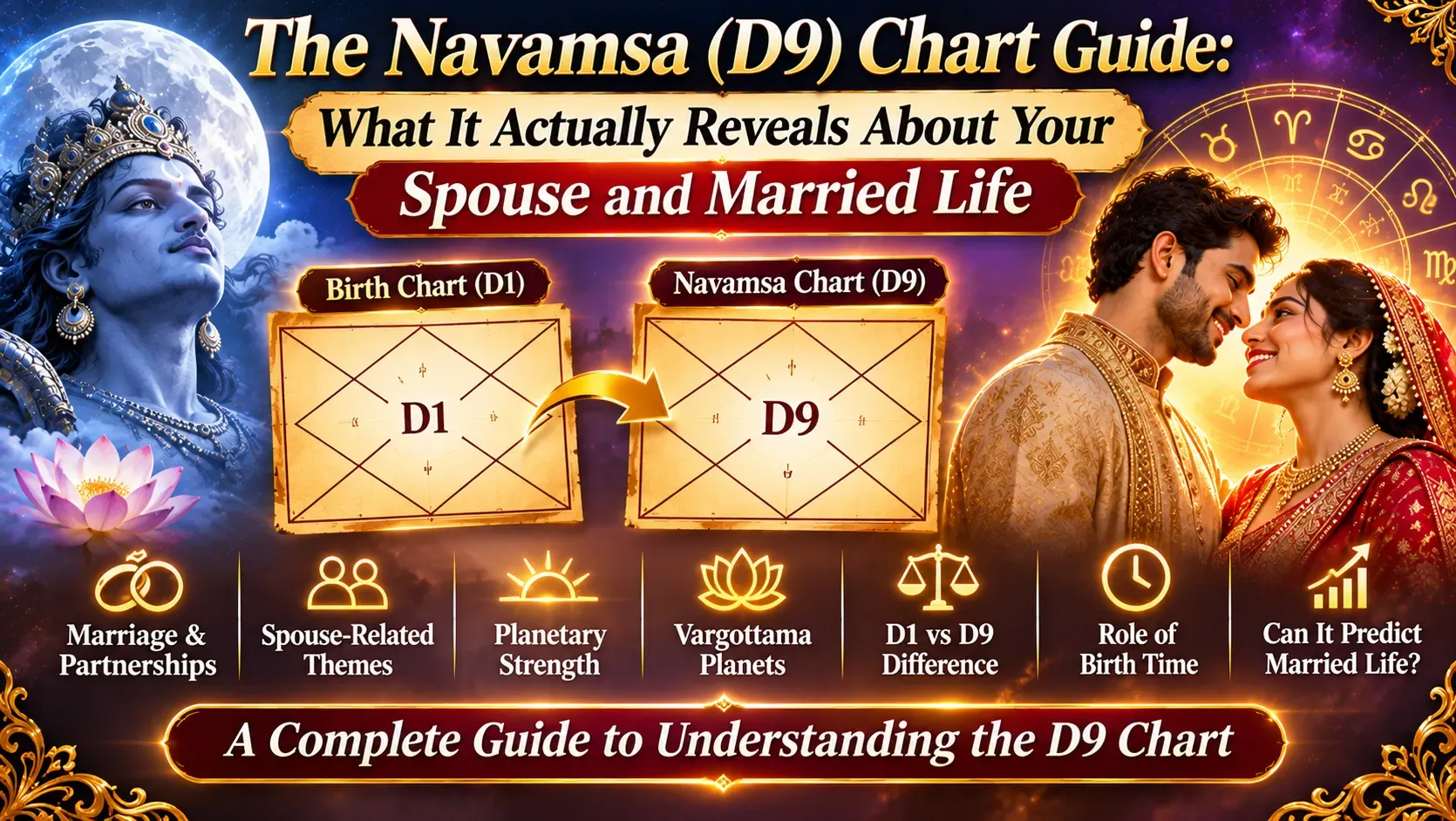
The Navamsa (D9) Chart Guide: What It Actually Reveals About Your Spouse and Married Life
Direct answer: The Navamsa chart, also called the D9 chart, is a divisional chart in Vedic astrology traditionally used to examine marriage, partnerships, dharma and the underlying strength of planets. Astrologers read it alongside the main birth chart (D1) to understand relationship-related themes. It does not identify your future spouse by name or guarantee how your married life will unfold. Accurate birth details, particularly the birth time, are important because even a small time difference can change the Navamsa ascendant.
If you have ever checked your Kundli and wondered why astrologers ask for the D9 chart, the reason is that the main birth chart is not the only chart used in traditional Vedic analysis.
The Navamsa provides another level of detail. It helps astrologers examine how planetary placements in the main chart are supported or modified when viewed through the ninth divisional chart.
Let's understand how it works.
What Is the Navamsa Chart in Vedic Astrology?
Navamsa means the ninth division of a zodiac sign.
In the D9 chart, each of the 12 zodiac signs is divided into nine equal parts. Each division measures 3°20'. These divisions are then mapped to zodiac signs according to traditional Navamsa calculation rules.
The resulting chart is used to examine:
- Marriage and long-term partnerships.
- Traditional interpretations of spouse-related themes.
- Dharma and personal development.
- The underlying strength of planetary placements.
- Vargottama planets, which occupy the same sign in D1 and D9.
The D9 chart is not a separate horoscope. Its purpose is to add detail to the main birth chart.
Why Is the D9 Chart Important for Marriage?
In Vedic astrology, the 7th house of the main birth chart is traditionally associated with marriage and partnerships.
The Navamsa provides another perspective on these matters. Astrologers may examine the D9 ascendant, its lord, the 7th house, the 7th house lord and Venus when studying marriage-related themes.
For example, a planet may appear strong in the D1 chart but occupy a less supportive position in the D9 chart. Astrologers consider both placements before interpreting its overall strength.
This is why reading only the 7th house of the main Kundli may provide an incomplete traditional assessment.
What Does the Navamsa Chart Reveal About Your Spouse?
The D9 chart is often used in traditional astrology to explore spouse-related characteristics and partnership themes.
Astrologers may examine:
- The 7th house and its lord in D9.
- Venus and its placement.
- The D9 ascendant and its ruling planet.
- Jupiter's influence and placement.
- Connections between the D1 and D9 charts.
These factors may be interpreted in relation to the nature of partnerships, relationship expectations and married life.
However, the D9 chart cannot reliably identify a future spouse's exact appearance, name, profession or background. Such claims should not be treated as certain predictions.
D1 vs D9: What Is the Difference?
Both charts have different roles in traditional Vedic astrology.
| Birth Chart (D1) | Navamsa Chart (D9) |
|---|---|
| Main birth chart | Ninth divisional chart |
| Maps planets and houses at birth | Divides each sign into nine parts |
| Provides the overall chart framework | Adds detail to planetary strength and marriage analysis |
| Used for broad life themes | Traditionally emphasised for marriage and dharma |
| Forms the foundation of chart interpretation | Must be interpreted alongside D1 |
The D9 should not be read independently. Its placements are meaningful when compared with the main birth chart.
Why Does Accurate Birth Time Matter for the D9 Chart?
Birth time is especially important when calculating divisional charts.
Each Navamsa division measures only 3°20'. The Navamsa ascendant can change roughly every 13 minutes, although the exact interval varies with the rising sign and location.
This means a small error in recorded birth time can change the D9 ascendant and the houses in the chart.
For example, someone whose recorded birth time is 7:10 AM may receive a different Navamsa ascendant if their actual birth time was closer to 7:25 AM.
The planetary Navamsa signs may remain unchanged in some cases, but the D9 ascendant and house placements can be particularly sensitive.
If possible, use the birth time recorded on an official birth record or confirmed by family documentation rather than relying on an approximate time.
What Is Vargottama in the Navamsa Chart?
Vargottama is a traditional astrological term used when a planet occupies the same zodiac sign in both the D1 and D9 charts.
For example, if Venus is in Taurus in the main birth chart and also in Taurus in the Navamsa chart, it is considered Vargottama.
In traditional interpretation, this is treated as a sign of consistency or stability in that planet's expression.
However, Vargottama does not automatically make every result favourable. The planet's house lordship, aspects, conjunctions and overall chart context still matter.
How to Check Your Navamsa (D9) Chart
You can calculate your D9 chart using your birth details.
Follow these steps:
- Open Astroly's Free Navamsa (D9) Calculator.
- Enter your date of birth.
- Provide your birth time as accurately as possible.
- Select your birthplace.
- Generate the chart and review your Navamsa ascendant and planetary placements.
- Compare the D9 placements with your main birth chart.
Astroly's calculator also displays the Navamsa sign of each planet and identifies Vargottama placements.
You can generate your Free Online Kundli to explore the main birth chart alongside your D9 results.
Can the Navamsa Chart Predict a Happy or Unhappy Marriage?
No chart placement can guarantee a happy or unhappy marriage.
In traditional astrology, the D9 is one of the charts examined when interpreting marriage-related themes. It is considered alongside the D1 chart, the 7th house, Venus, Jupiter and relevant planetary periods.
Real married life also depends on communication, mutual respect, shared responsibilities, emotional understanding and individual choices.
The Navamsa should be treated as a traditional interpretive tool, not as a final verdict on a relationship.
Want to Understand Your D9 Chart in Detail?
If you want to explore your marriage-related planetary placements, begin with your Navamsa D9 Calculator on Astroly.
You can also generate your Free Online Kundli and compare the main birth chart with the D9 chart.
For questions about your 7th house, Navamsa ascendant or spouse-related placements, you can chat with an astrologer on Astroly and discuss your chart.
Frequently Asked Questions
1. What is the Navamsa chart used for?
The Navamsa or D9 chart is traditionally used to examine marriage, partnerships, dharma and the underlying strength of planets in Vedic astrology.
2. Is the D9 chart more important than the D1 chart?
No. The D9 does not replace the main birth chart. It is interpreted alongside D1 to provide additional detail.
3. Does the Navamsa chart reveal the appearance of a future spouse?
Some astrologers interpret planetary placements in D9 to discuss traditional spouse-related characteristics. However, it cannot reliably determine a person's exact physical appearance or identity.
4. How accurate should birth time be for the Navamsa chart?
Birth time should be as accurate as possible. A Navamsa division is 3°20' wide, and the D9 ascendant can change roughly every 13 minutes, depending on the rising sign and location.
5. What is Vargottama in D9?
A planet is called Vargottama when it occupies the same zodiac sign in both the D1 and D9 charts. Traditional astrology interprets this as a form of planetary stability.
6. Can the D9 chart show marriage timing?
The D9 may be considered during marriage analysis, but timing is generally examined through the main birth chart, relevant planetary periods and transits together. The D9 alone is not sufficient.
Final Thoughts
The Navamsa chart adds an important layer to traditional Vedic birth-chart interpretation, particularly when studying marriage, partnerships and planetary strength.
But it should never be treated as an independent horoscope or a guaranteed prediction of married life.
Start with an accurately calculated D1 chart, examine the D9 alongside it and pay attention to the 7th house, its lord and relevant planetary influences.
The value of the Navamsa lies in adding context to your birth chart, not replacing it.
Disclaimer: This article explains traditional Vedic astrology concepts for educational purposes. Astrological interpretations vary by tradition and calculation method. Astrology is not a scientifically established method of predicting marriage outcomes or identifying a future spouse.