Introduction
Every year, thousands of Indian families sit across the table from an astrologer and hear the same phrase: "gunas matched." But how rare is a 36 guna match, actually? Most people assume it's rare simply because they've never seen one. That assumption is correct, though the real reason has more to do with planetary math than luck. A perfect 36 out of 36 sounds like the gold standard of marriage compatibility, yet in practice, most solid matches land somewhere between 18 and 32. This article breaks down why the perfect score is so hard to get, what score actually counts as good, and how you can check your own guna milan without guesswork, using the Astroly app.
What Guna Milan Actually Measures
Guna Milan, also known as Ashtakoot Milan, is a compatibility system used in Vedic astrology to compare two horoscopes before marriage. It looks at the position of the Moon and birth star (nakshatra) for both people and scores them across eight categories, or koots.
The Eight Koots and Their Points
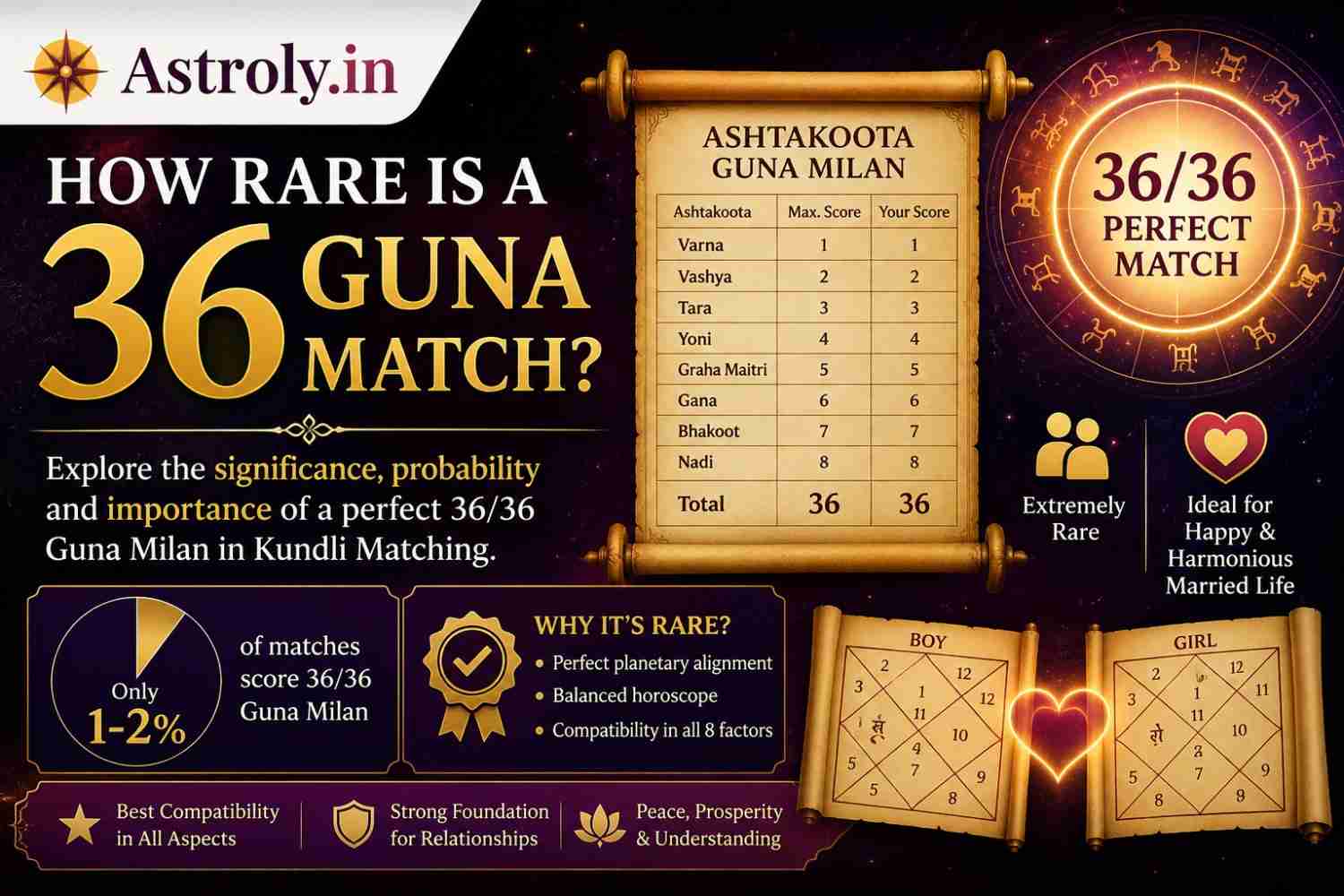
Here's how the 36 points are split up:
- Varna (spiritual outlook) – 1 point
- Vashya (mutual attraction and control) – 2 points
- Tara (health and general well-being) – 3 points
- Yoni (physical compatibility) – 4 points
- Graha Maitri (mental connection) – 5 points
- Gana (temperament) – 6 points
- Bhakoot (family and financial harmony) – 7 points
- Nadi (health and genetic compatibility) – 8 points
Add these together and you get 36. That's where the "36 guna match" comes from, and why it's treated as the theoretical ceiling.
So, How Rare Is a 36 Guna Match?
Rare enough that many astrologers with 20+ years of practice say they've seen it maybe once or twice, if at all.
Why the Odds Are So Low
For all eight koots to line up perfectly, both charts need an almost identical planetary pattern. With 27 possible nakshatras and several planetary combinations layered on top, the odds of every single koot matching are slim. Most practicing astrologers put the real-world frequency of a genuine 36/36 at under 1% of the matches they evaluate.
The Nadi Koot Is Usually the Deal-Breaker
Nadi carries 8 points, more than any other koot. If both partners share the same Nadi, it triggers what's called Nadi Dosha, and the score drops hard unless it's cancelled out by other planetary factors. Since this single koot is worth almost a quarter of the total score, it's usually the reason a perfect match never happens.
What Score Should You Actually Aim For?
You don't need 36 to have a strong marriage match. Traditional astrology gives a much more practical range to work with.
Realistic Compatibility Benchmarks
- Below 18 – Usually not recommended without deeper chart review
- 18 to 24 – An average, workable match
- 25 to 32 – A very good match
- 32 to 36 – Excellent, and genuinely rare
A score in the high 20s is often treated as a green light by most astrologers. That's a far more realistic target than chasing perfection.
It's Not Just the Total Score That Counts
Two couples can have the same total score and still be in very different situations. What matters more is which koots are strong. Good scores in Gana, Bhakoot, and Nadi tend to matter more for long-term harmony than the overall number.
Myths People Believe About the 36 Guna Match
A few misconceptions keep circulating around this topic, mostly because a perfect score is so hard to picture in real terms.
"You need 36 for a happy marriage"
Not true. Countless successful marriages have guna scores in the low-to-mid 20s. The score is meant to guide the decision, not dictate it.
"A low score means the marriage will fail"
A lower guna score on its own doesn't predict failure. Manglik status, dasha periods, and the overall strength of both individual charts matter just as much, sometimes more.
"Guna Milan is the only thing that matters"
It's one part of a bigger picture. Experienced astrologers also study the Navamsa chart and individual planetary doshas before forming an opinion.
How to Check Your Own Guna Milan Score
Rather than wondering where you'd land, it's easier to just calculate it properly.
Why Manual Calculation Is Risky
Working out an Ashtakoot score by hand means identifying the correct nakshatra, Moon sign, and koot-by-koot rules for both people. One small error in birth time or place can throw off the entire result.
Using Astroly to Get an Accurate Report
The Astroly app handles this calculation for you. Enter both partners' date, time, and place of birth, and it generates a full Ashtakoot breakdown along with dosha alerts within seconds.
Steps to Match Kundlis on Astroly
- Download the Astroly app or visit astroly.in
- Enter your birth details and your partner's
- View your instant guna milan score with a koot-by-koot breakdown
- Check for dosha flags such as Nadi Dosha or Bhakoot Dosha
- Talk to an in-app astrologer if you want a deeper reading
Once it's set up, you're not just getting a one-time report. The app also sends you daily horoscope updates, planetary transit alerts, and personalized predictions, so you stay informed well beyond your matchmaking report.
Conclusion: Aim for Compatibility, Not Perfection
So, how rare is a 36 guna match? Rare enough that most astrologers may go their entire career without seeing one. Instead of holding out for a perfect score, look for something above 25, with solid Nadi and Bhakoot compatibility and no major unresolved doshas.
If you're getting ready for marriage, or just curious where you stand, don't rely on rough manual math. Download the Astroly app today for an accurate guna milan report in minutes, plus daily astrology updates delivered straight to your phone.
Frequently Asked Questions
Q1. How rare is a 36 guna match in real life? Genuinely rare. Most astrologers estimate a true 36/36 shows up in fewer than 1% of matches they review, largely because the Nadi koot alone can block a perfect score.
Q2. Is a 36 guna match necessary for marriage? No. A score of 18 or above is generally considered workable, and 25 to 32 is treated as a very good match. Perfection isn't the requirement.
Q3. What's considered a good guna milan score? Anywhere from 25 to 32 out of 36 is typically seen as very good, while 32 and above is considered excellent and rare.
Q4. Can a low guna score still lead to a happy marriage? Yes. Other factors like Manglik status, dasha periods, and overall chart strength often matter just as much as the guna total.
Q5. How do I check my own guna milan score accurately? Enter both partners' birth details into the Astroly app for an instant, detailed Ashtakoot compatibility report.
Q6. Which koot is hardest to match? Nadi, worth 8 points, is usually the toughest koot to match and the most common reason couples don't hit a perfect 36.