Introduction
I remember the first time I looked at my birth chart. It was a mess of lines, symbols, and numbers — and I had absolutely no idea what any of it meant.
Fast forward a few years, and that same chart told me more about myself than a decade of journaling ever did.
That is the power of a birth chart calculator. It takes your date of birth, your time of birth, and where you were born — and produces a snapshot of the sky at the exact moment you arrived in this world. Every planet, every degree, every angle — frozen in time, just for you.
At , our free birth chart calculator gives you that snapshot instantly. Whether you are curious about your Moon sign, your Rising sign, or why you clash so badly with certain people — your natal chart has answers.
This guide walks you through everything. What the tool does, how to read what it gives you, and which placements actually matter. No jargon, no fluff — just real, useful astrology.
What Exactly Is a Birth Chart Calculator?
Let's start simple.
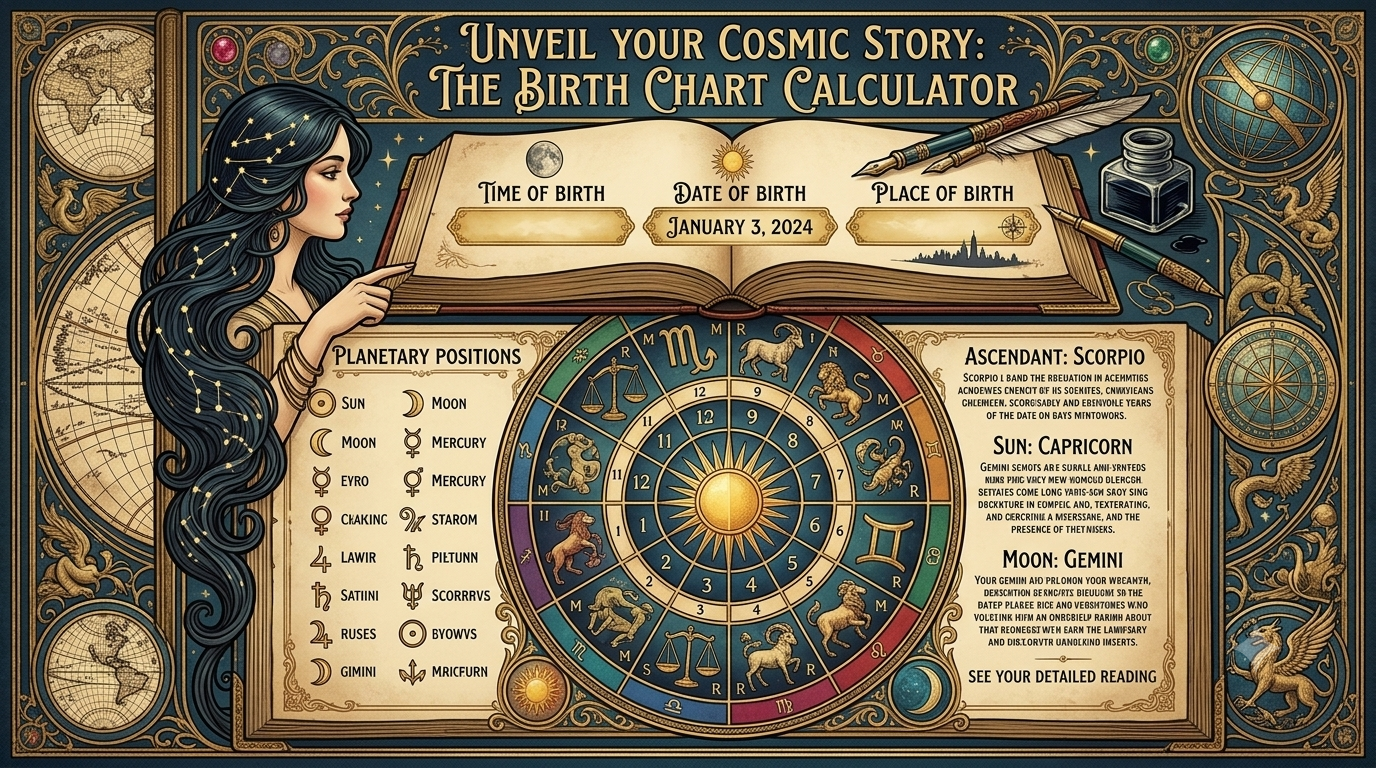
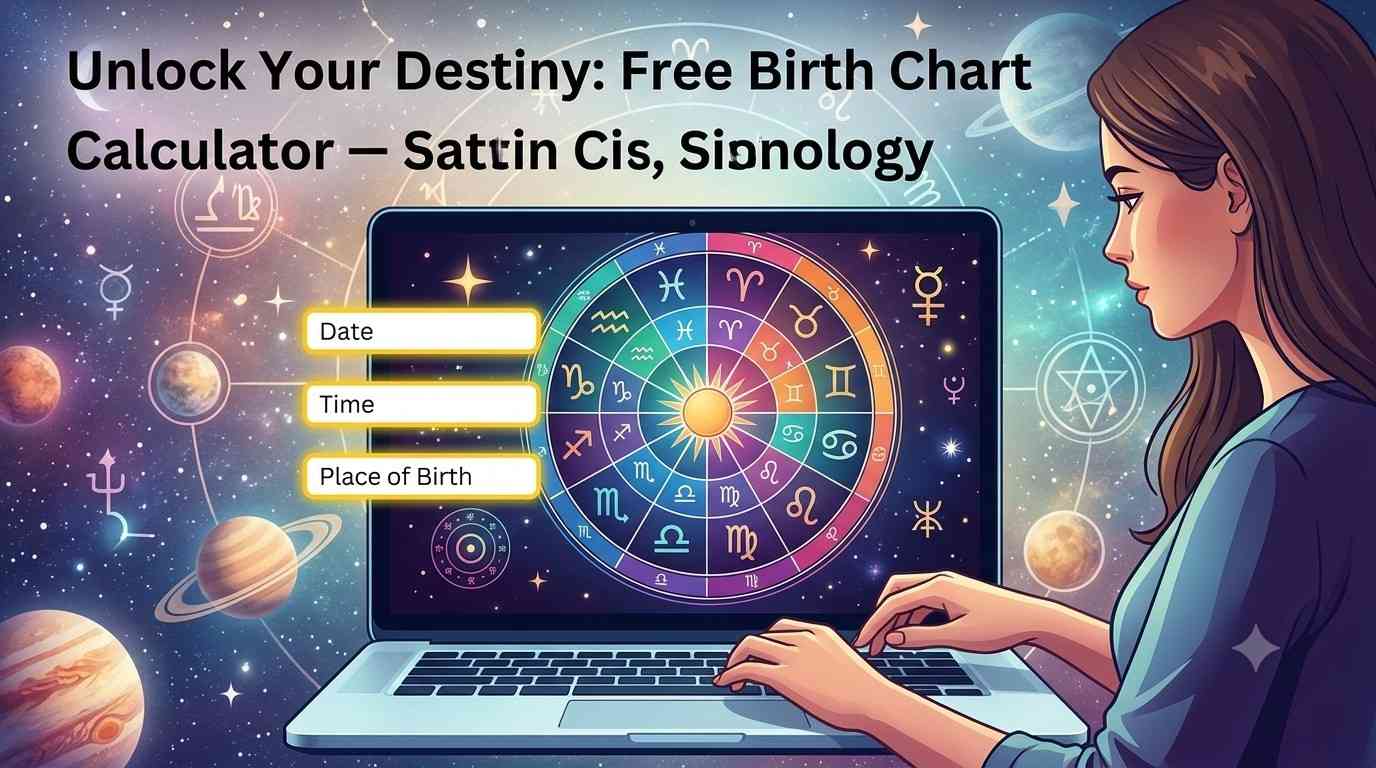
A birth chart calculator is an online tool that maps where every planet in our solar system was positioned the moment you were born. The result is a circular diagram called a natal chart — divided into 12 sections called houses, with the 12 zodiac signs spread around the wheel.
Think of it as a cosmic photograph taken at your birth. The Sun was somewhere. The Moon was somewhere else. So were Mars, Venus, Saturn, and every other planet. The calculator figures out exactly where each one sat — and that placement shapes you in specific, documented ways.
What the Calculator Actually Does Behind the Scenes
It sounds mystical, but the math is precise. Astroly's birth chart calculator uses Swiss Ephemeris data — the same planetary database professional astrologers and astronomical observatories rely on. It computes planetary longitudes to the exact degree and minute.
The calculator then:
- Plots each planet within one of the 12 zodiac signs
- Places each planet within one of the 12 houses
- Calculates the angles (called aspects) between planets
- Determines your Ascendant — the zodiac sign that was rising on the eastern horizon when you were born
This is not guesswork. It is geometry applied to astronomy, interpreted through thousands of years of astrological observation.
Why Your Birth Time Is So Important
Here is something most beginners do not realize — your birth time matters enormously.
The Moon moves through a full zodiac sign in roughly 2.5 days. The Ascendant shifts by one full sign roughly every two hours. So if your recorded birth time is off by even 20 minutes, your Rising sign could be different from what the calculator shows.
Always use your birth certificate if possible. Hospital records are the next best option. If you genuinely do not know your time, enter 12:00 PM as a placeholder — your Sun and Moon placements will still be accurate, but treat any house-related interpretations loosely.
How to Use the Birth Chart Calculator on Astroly
Using Astroly's tool takes about 45 seconds. Here is exactly what to do.
Enter Your Three Details
Go to the Birth Chart Calculator page on . You will see three fields:
Date of Birth — straightforward. Day, month, year.
Time of Birth — enter as precisely as you know it. Astroly accepts both 12-hour and 24-hour formats.
Place of Birth — type your city name and select from the dropdown. The tool has a global location database, so even smaller Indian cities and towns are supported.
Pick Your Astrology System
This step trips up a lot of beginners.
Astroly supports two systems — Western (Tropical) astrology and Vedic (Sidereal) astrology. They use different starting points for the zodiac, which means your Sun sign in Western astrology might differ from your Sun sign in Vedic astrology by about one sign.
Not sure which to choose? A simple rule of thumb:
- If you want to explore personality, psychology, and modern self-development astrology — go Western
- If you want predictive readings, karma-based insights, or traditional Indian Jyotish — go Vedic
You can run the calculator both ways and compare. Many people do.
Read What the Calculator Gives You
Click the calculate button and your chart appears. You will get:
- A visual wheel showing all 12 houses and where each planet falls
- A table listing every planet, its zodiac sign, its degree, and which house it occupies
- Your Ascendant, Midheaven (MC), and lunar nodes
- Written interpretations for your key placements
Do not try to read everything at once. Start with your Sun, Moon, and Rising sign. Those three — what astrologers call the "Big Three" — give you 80% of what you need to understand your core personality.
Understanding What Your Natal Chart Is Actually Saying
A birth chart looks complicated because it is layered. But it is not random. Every element follows a logic.
Here is how to break it down.
The 12 Zodiac Signs: The "How"
The signs describe how a planet expresses its energy. Mars in Aries is fierce and direct. Mars in Pisces is sensitive and indirect. Same planet, wildly different behavior — because the sign filters it.
Each sign has a ruling planet, an element (fire, earth, air, water), and a mode (cardinal, fixed, mutable). These qualities shape the flavor of every placement in your chart.
The 12 Houses: The "Where"
If signs describe how, houses describe where — which area of life a planet's energy plays out in.
| House | What It Governs |
|---|---|
| 1st | Your identity, body, first impressions |
| 2nd | Money, self-worth, what you value |
| 3rd | Communication, siblings, your local world |
| 4th | Home, family, emotional foundation |
| 5th | Creativity, romance, children, joy |
| 6th | Daily work, health habits, routines |
| 7th | Partnerships, marriage, open enemies |
| 8th | Transformation, shared money, depth |
| 9th | Beliefs, travel, higher learning |
| 10th | Career, public reputation, legacy |
| 11th | Friends, community, long-term goals |
| 12th | Solitude, spirituality, hidden patterns |
So Saturn in the 7th house? Lessons and delays around partnerships. Venus in the 2nd? Natural ease with money and a deep love of beautiful things. The combinations are endless — which is why every chart tells a different story.
Aspects: The Conversations Between Planets
Aspects are the angles planets make to each other. They show which parts of your chart work together and which ones create friction.
Trines (120°) — natural talent, easy flow. Things that come without trying.
Squares (90°) — tension, challenge, but also motivation. The placements that push you to grow.
Oppositions (180°) — a tug of war between two energies, often played out through relationships.
Conjunctions (0°) — two planets blending their energies, for better or worse depending on which planets.
Sextiles (60°) — gentle opportunities that need a little effort to activate.
When you look at your chart, the lines drawn across the center of the wheel are aspects. They show you where your inner conflicts and your natural gifts live.
The Placements That Matter Most in Your Chart
People often obsess over their Sun sign and ignore everything else. That is like judging a book by reading just the title.
Here are the placements that deserve your attention first.
Your Sun Sign: What You Are Here to Become
Your Sun sign is not just "your sign." In traditional astrology, the Sun represents your life purpose — the identity you are consciously building throughout your life. Many people do not fully embody their Sun sign until their 30s or 40s. It is more of an aspiration than a description of who you already are.
Your Moon Sign: Who You Are When No One Is Watching
The Moon governs your emotional world. Your instincts. Your comfort needs. The version of you that shows up at home, or when you are stressed, or with people you truly trust.
This is why two people with the same Sun sign can be so different — their Moon signs tell the real story. A Capricorn Sun with a Scorpio Moon is an entirely different creature from a Capricorn Sun with a Gemini Moon.
Your Rising Sign: The Door Through Which People Enter You
Your Ascendant is the face you present to the world — not fake, exactly, but curated. It is how people perceive you when they first meet you, and it governs your physical appearance and general demeanor.
It also sets up your entire house structure. Whichever sign your Ascendant is in becomes your 1st house, which means it determines where every other house falls. This is why birth time matters so much — change the Rising sign and the whole chart reorganizes itself.
Saturn: Where Life Gets Serious
Saturn shows where you face restriction, discipline, and hard-earned lessons. It is rarely comfortable. But Saturn placements are often where your greatest long-term achievements live, if you do the work.
Saturn in the 10th house? Career requires serious, sustained effort — but the payoff can be enormous. Saturn in the 5th? Creativity and joy may not come naturally, but developing them becomes one of life's most meaningful projects.
Why Astroly's Birth Chart Calculator Stands Apart
There is no shortage of free birth chart tools online. So why do tens of thousands of Indians — and users worldwide — choose Astroly?
A few honest reasons.
It Handles Both Western and Vedic Astrology Properly
Most Western tools are built entirely around Tropical astrology. Most Vedic tools ignore Western astrology. Astroly does both, and does both well. If you grew up in India reading your Jyotish chart but also want to explore your Western placements, you do not need two separate tools.
The Interpretations Are Written by Practicing Astrologers
The written readings you get with your chart were not auto-generated with generic text. They were developed by Astroly's team of experienced astrologers, with attention to nuance. A Moon in Scorpio reading, for instance, does not just say "intense emotions" — it talks about the specific psychological patterns, trust issues, and regenerative capacity that placement produces.
It Is Actually Free — No Tricks
Some tools show you a teaser and lock the real chart behind a paywall. Astroly's birth chart calculator gives you the full chart and basic interpretations at no cost, with no email required. Premium reports go deeper, but the core tool is genuinely free.
It Works on Your Phone
The entire tool is built to work smoothly on mobile — which matters in India, where most people browse on a phone. The chart wheel renders cleanly, the tables are scrollable, and the whole experience does not require a desktop to use properly.
Frequently Asked Questions
What details do I need to calculate my birth chart?
Three things: your date of birth, your time of birth (as precise as you can get), and the city where you were born. If you have all three, the calculator gives you a complete natal chart in seconds.
My Sun sign is different in Vedic astrology. Which one is correct?
Both are correct — they just use different systems. Western astrology uses the Tropical zodiac, anchored to the seasons. Vedic astrology uses the Sidereal zodiac, anchored to actual star positions. The roughly 23-degree difference between them means your Sun often falls in a different sign. Neither is "wrong" — they simply ask different questions about your life.
I do not know my exact birth time. Is the chart still useful?
Yes, with some limitations. Your Sun sign, most planetary positions, and many key placements will still be accurate. What you lose is the Ascendant, the Midheaven, and your house structure — which are the time-sensitive parts. Use 12:00 PM as a default and take house-based readings as approximate.
Can a birth chart predict what is going to happen to me?
Not in a deterministic way. A birth chart shows your tendencies, patterns, natural gifts, and recurring challenges. Predictive techniques — like planetary transits or Vedic dashas — can suggest likely themes in specific time periods. But the chart does not lock in a fixed fate. It gives you information. What you do with it is your call.
What is the North Node and why does it matter?
The North Node (called Rahu in Vedic astrology) points to your soul's direction in this lifetime — the qualities and experiences you are being pulled toward, even if they feel unfamiliar or uncomfortable. It sits opposite the South Node, which represents what you are naturally good at but may need to move beyond. Together, they describe your karmic axis.
How is a birth chart different from my daily horoscope?
A daily horoscope is written for all people born under the same Sun sign — roughly one-twelfth of the global population. A birth chart is unique to you. It accounts for your exact planetary placements, house positions, and aspects. The two are not really comparable in depth.
Does the birth chart change over time?
Your natal chart is fixed — it describes the sky at your moment of birth and never changes. What does change are the current planetary positions, which interact with your natal chart in real time. These interactions are called transits, and tracking them is how astrologers describe what themes are active in your life right now.
Can I use Astroly's birth chart calculator for someone else?
Yes. You just need their birth details. Many people calculate charts for family members, partners, or friends to better understand their personalities and dynamics.
Is astrology real?
That depends on what you mean by "real." Astrology does not work like physics. Its claims cannot be tested in a laboratory the way a chemical reaction can. What it does offer is a rich symbolic framework that many people — across cultures, across centuries — have found remarkably accurate as a map of personality and life themes. Whether you approach it as spiritual practice, psychological tool, or just personal curiosity, what matters is whether it is useful to you.
Does Astroly offer personal consultations?
Yes. Beyond the free calculator, Astroly connects you with experienced astrologers for one-on-one readings. If you want someone to interpret your chart in detail — your career path, your relationship patterns, the timing of major decisions — a personal consultation goes far deeper than any automated tool.
Final Thoughts
Your natal chart is not a fortune cookie. It is not a verdict on your life.
It is a map — one of the most detailed personal maps you will ever have access to. It reflects the specific energies you were born into and the particular patterns that run through your psychology, your relationships, and your choices.
A good birth chart calculator is the starting point. What you do with that information — the curiosity you bring to it, the self-reflection it sparks — that is where astrology actually becomes valuable.
Astroly.in gives you that starting point for free. Accurate calculations, both Western and Vedic, with real interpretations written by people who know what they are talking about.
Go see what your chart says.
It takes less than a minute. What you discover might take much longer to fully absorb — and that is exactly the point.