My grandmother never missed a single day of checking the Panchang. Every morning, before chai, before anything else, she'd pull out that thick printed almanac and spend ten minutes finding today's tithi, checking the nakshatra, and marking down when Rahu Kaal started. She knew this like she knew her own name.
Most of us don't have that habit — or that almanac. But the need is still there. Before an interview, before signing papers for a new house, before fixing a wedding date, before any big decision—you want to know if the timing is right. That's exactly why Daily Panchang on WhatsApp exists.
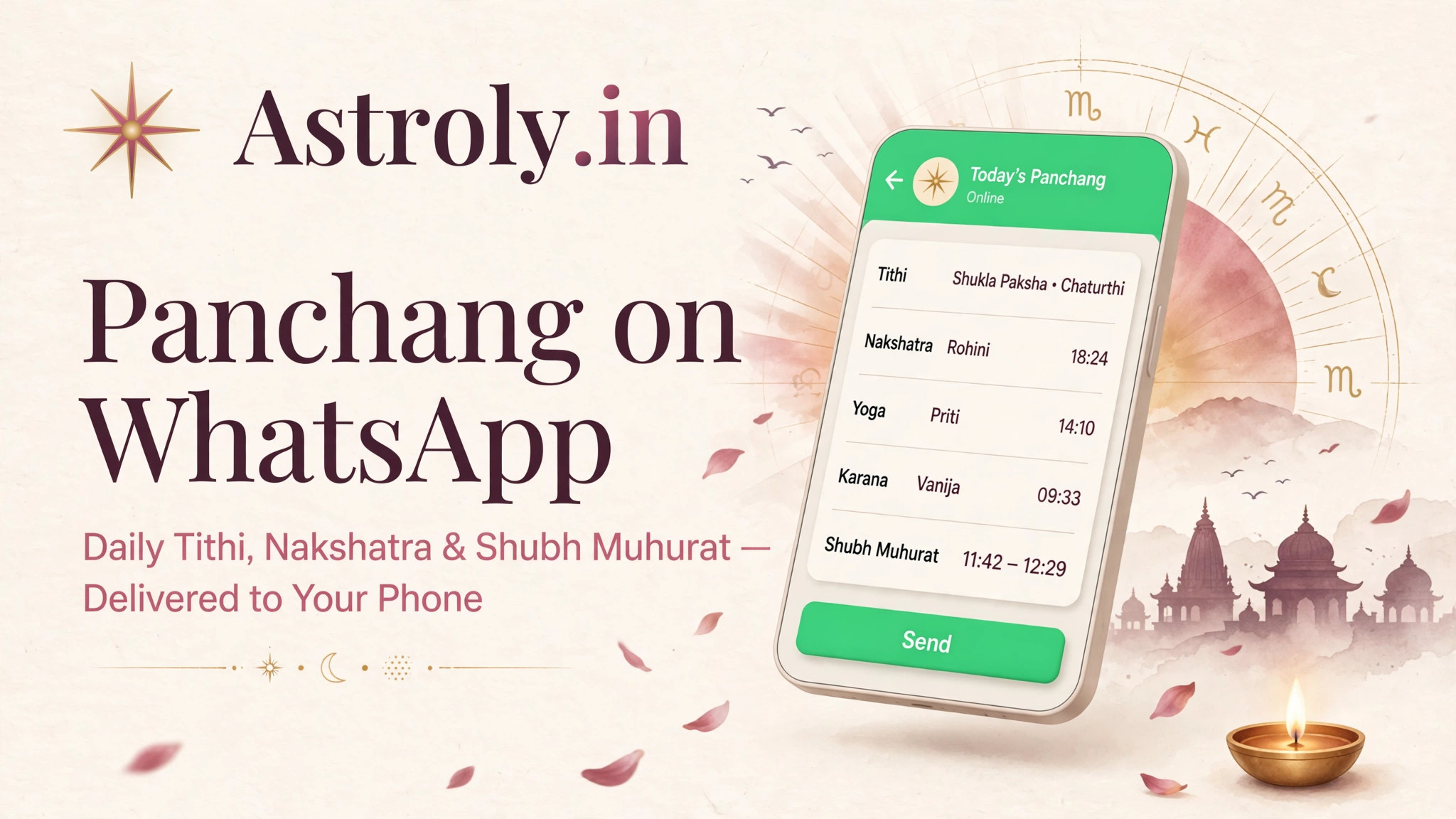
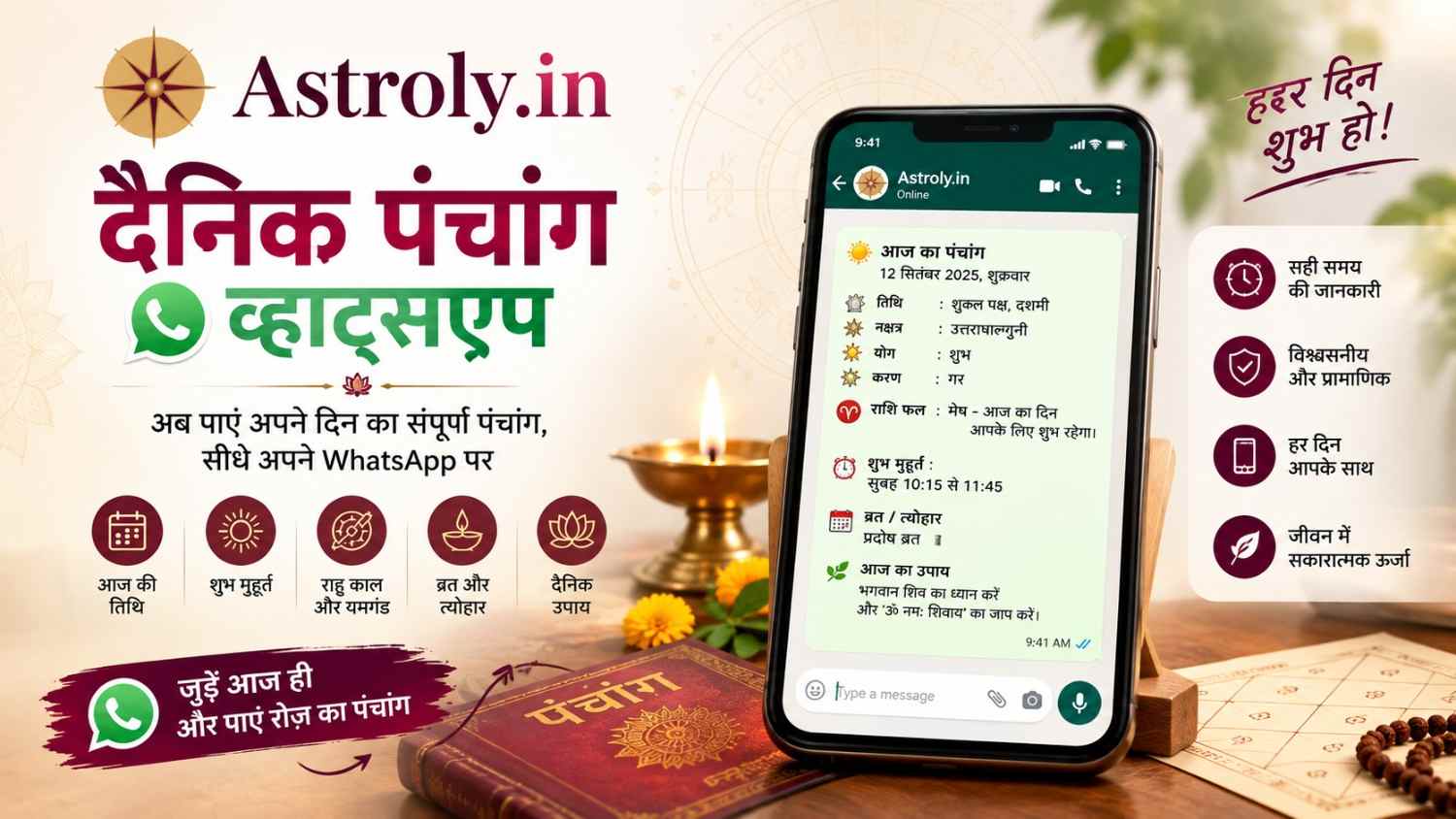
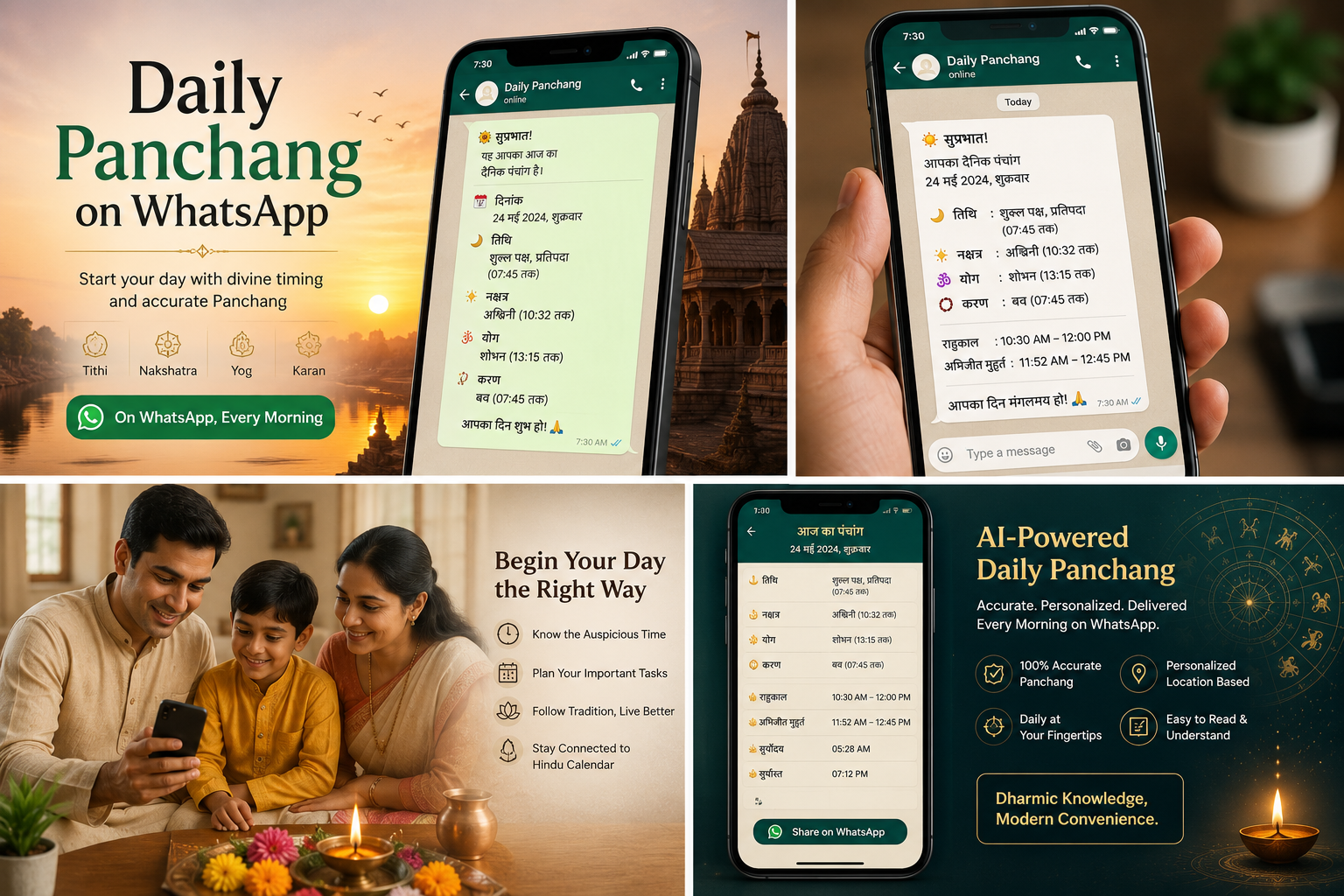
Astroly.in now sends your complete daily Panchang straight to your WhatsApp every morning. Tithi, nakshatra, yoga, rahu kaal, muhurats—all of it, calculated specifically for your city, waiting in your phone before you've finished brushing your teeth. No app to open. No website to search. Just your morning update, right there in WhatsApp where you already spend your time.
This guide explains everything — what the Panchang actually contains, why WhatsApp makes it so much more practical than any other format, and how you can set it up for free in about two minutes.
The Five Things a Panchang Actually Tells You
People hear the word "Panchang" and think it's complicated. It isn't. The word itself breaks it down — panch means five, anga means part. Five parts. That's it.
Tithi: The Lunar Day
The Moon moves roughly 12 degrees relative to the Sun each day. That gap creates a tithi. There are 30 tithis in a lunar month—15 in the bright half (Shukla Paksha) and 15 in the dark half (Krishna Paksha).
Why does it matter? Because different tithes carry different qualities. Purnima (full moon) and Ekadashi are considered auspicious for prayer and fasting. Amavasya (new moon) is a time for ancestor rituals. Some tithis are better for travel, others for starting something new. Your grandmother knew this without thinking about it. Your Daily Panchang WhatsApp update tells you this before 7 AM.
Vara: The Day's Planetary Ruler
Every day of the week belongs to a planet. Sunday to the Sun, Monday to the Moon, Tuesday to Mars, and so on. The ruling planet shapes the general character of the day — its energy, its strengths, its limitations.
This isn't abstract. Ask any traditional jeweler when customers walk in to buy gold. Ask any farmer when they prefer to sow seeds. The vara matters in practice.
Nakshatra: Where the Moon Is Tonight
The Moon travels through 27 nakshatras (lunar mansions) during the month, spending roughly a day in each. The nakshatra on a given day affects everything from your mood to your relationships to how smoothly your work flows.
Certain nakshatras are ideal for travel. Others for health-related decisions. Some are avoided for weddings altogether. Knowing the day's nakshatra helps you understand the quality of the time you're working with.
Yoga: The Sun-Moon Combination
Take the positions of the Sun and Moon, add them together, and divide by a fixed unit—and you get one of 27 yogas. Some are exceptionally auspicious. Amrita Yoga, for example, is considered so fortunate that almost any positive action taken during it is said to succeed. Others, like Vishkambha, are approached with more caution.
This is the element most people overlook. It's also one of the most useful.
Karana: The Half-Day
Each tithi is split into two karanas—so you get roughly 60 karanas in a month. This is the most granular element of the Panchang, and it's especially useful for timing actions within the same day. If you need to choose between a morning meeting and an afternoon one, the karana can help guide that choice.
What Else Your Daily Panchang WhatsApp Message Contains
Beyond the five core elements, a proper Panchang covers several more things your daily update will include.
Rahu Kaal—The One Timing Almost Everyone Knows
Rahu Kaal is the period each day considered inauspicious for starting new tasks. It shifts daily and lasts roughly 90 minutes. The old rule: don't begin anything important during Rahu Kaal.
In cities across India, you'll still find shopkeepers who won't open a new account during this window. Families who won't depart for a journey. The tradition is alive. Your morning Panchang message gives you the exact Rahu Kaal timing for your city—so you can plan around it without having to calculate anything yourself.
Brahma Muhurat — The Golden Morning Window
The Brahma Muhurat falls roughly 1.5 hours before sunrise. Ancient texts describe it as the most powerful time for meditation, mantra chanting, and learning. Even if you just use it for quiet thinking before the day begins, the timing is worth knowing.
Abhijit Muhurat — The Universal Auspicious Window
This is a roughly 48-minute window around solar noon, considered universally auspicious regardless of other factors. Vedic tradition holds that almost any work begun during Abhijit Muhurat carries extra momentum. Knowing when it falls today takes about two seconds when it's in your WhatsApp message.
Festival and Vrat Alerts
Your Astroly.in update also includes advance notice—typically seven days ahead—of upcoming festivals and fasting days. Ekadashi, Pradosh, Amavasya, Navratri, major regional festivals — they appear in your update before they arrive. No more realizing at 8 PM that tomorrow is an Ekadashi you forgot to prepare for.
Why WhatsApp Is Actually the Right Format for This
There's a reason Astroly.in chose WhatsApp and not an app, not email, not SMS. It comes down to a simple reality: WhatsApp is where Indians actually spend their mornings.
You're Already There
Over 500 million people in India use WhatsApp. Most check it within minutes of waking up. Delivering your Panchang there means it reaches you in the flow of your morning — not as a separate task requiring a separate app.
Think about the alternative. A dedicated app means: remember to open it, navigate to today's date, find the information, then go back to your morning. Most people stop doing that within a week. WhatsApp notifications, though? Those get seen.
The Sharing Problem Is Solved
This might be the most underrated benefit. When you receive your morning Panchang on WhatsApp, sharing it with your family takes one tap. Your parents get it. Your spouse gets it. Your children get it. Anyone planning a trip or a ceremony that day gets the same information.
Try doing that with a printed almanac.
No Technical Barriers for Anyone
The Astroly.in WhatsApp message is designed to be readable by anyone — including elderly family members who find apps confusing. Large text, clear structure, no menus to navigate. It arrives. You read it. That's the whole process.
Getting Set Up: How the Subscription Works
The setup is genuinely simple. Here's the actual process.
Step 1: Go to Astroly.in
Visit on your phone or computer. You'll see the WhatsApp Panchang subscription clearly on the homepage — it's not buried anywhere.
Step 2: Share Your Details
Enter your name, your WhatsApp number with country code, and your city. That city information is important — it's what allows the platform to give you location-specific timings rather than generic ones.
Step 3: Confirm via WhatsApp
Astroly.in sends a confirmation message to your WhatsApp. Reply as instructed. This one step ensures you've opted in and that the number is correct. The whole thing takes about 90 seconds.
Step 4: It Arrives Tomorrow Morning
Your first update arrives the next morning. After that, it comes every day — typically between 6 and 7 AM. You'll start your day knowing exactly what kind of day it is, astronomically speaking.
About the Cost
The Daily Panchang WhatsApp subscription is free. Astroly.in also offers paid services — personalized kundali readings, specific muhurat selection for events, compatibility analysis — but the daily Panchang itself doesn't cost anything. No trial period. No credit card required. Just free.
To unsubscribe, reply STOP to any message. Done instantly.
How Real Families Actually Use Their Daily Panchang
The Panchang isn't just for priests and astrologers. Here's how ordinary families use it every day.
For Personal Timing
Before important meetings, many people check whether the day's nakshatra and yoga are supportive. Before travel, they note the vara and avoid departing during Rahu Kaal. Before making a significant financial decision, they verify they're not acting on an inauspicious tithi.
This isn't superstition — it's the same logic as checking the weather before a picnic. You're using available information to make better decisions.
For Spiritual Practice
The Brahma Muhurat reminder helps people maintain a morning meditation or prayer routine. The vrat alerts help them prepare for fasting days with enough notice to adjust meals and schedules. The festival alerts keep the family calendar aligned with the Hindu calendar without anyone having to track it manually.
For Ceremonies and Events
When families are planning weddings, griha pravesh (house entry), business launches, or naming ceremonies, the daily Panchang gives them a starting point. They can identify potentially strong days before consulting a family astrologer for a detailed muhurat selection.
For Business Owners
Many traditional and modern Indian business owners still use Panchang timing for significant decisions — new product launches, shop openings, important contracts. The daily WhatsApp update keeps this information accessible without requiring them to maintain a separate practice around it.
A Word on Accuracy — Because It Matters
Not all Panchang sources are equal. Some apps use approximated data. Some websites recycle the same timings regardless of your location. That's a real problem when you're making decisions based on what you read.
Astroly.in calculates Panchang data using Swiss Ephemeris — the same astronomical computation system used by professional astrologers and researchers internationally. Every sunrise, every nakshatra transition, every Rahu Kaal window is computed based on your city's actual geographic coordinates.
The difference this makes: Rahu Kaal in Mumbai on a given morning might fall between 7:30 and 9:00 AM. In Delhi, it might be 9:00 to 10:30 AM. In Chennai, different again. If your Panchang doesn't account for your location, you're working with the wrong timings entirely.
Astroly.in gets this right, and it's one of the main reasons subscribers trust the service.
Frequently Asked Questions
What exactly does the Daily Panchang WhatsApp message include?
Every morning message from Astroly.in covers the five Panchang elements (tithi, vara, nakshatra, yoga, karana), Rahu Kaal timings, Brahma Muhurat, Abhijit Muhurat, sunrise and sunset for your city, and advance alerts for upcoming festivals and vrats.
Is it actually free, or is there a catch?
It's genuinely free. The daily Panchang delivery has no cost. Astroly.in offers paid consultations and services separately, but they don't require you to purchase anything to receive your daily update.
How accurate are the timings?
Very accurate. The platform uses Swiss Ephemeris calculations and your specific city coordinates. Timings are precise to the minute for your location — not generic national averages.
Can I get it in Hindi?
Yes. Astroly.in currently offers the daily update in both English and Hindi. Additional regional language support is being expanded through 2026.
What if I move to a different city?
Just message Astroly.in via WhatsApp with your new city. They'll update your location and recalibrate all your timings accordingly.
Will they send me ads or promotional messages?
No. You receive one message per day — your morning Panchang. The service doesn't spam. If you ever want to stop, reply STOP and it ends immediately.
Is my phone number safe?
Yes. Astroly.in doesn't sell or share subscriber data with third parties. Your number is used only for delivering your daily update.
Can I forward it to my family?
Absolutely — that's one of the best features. One tap and everyone in your family group has the same information. A lot of subscribers specifically share it with their parents every morning.
What time does the message arrive?
Typically between 6:00 and 7:00 AM local time. It's designed to reach you before your morning routine really gets going.
What if I want help with a specific muhurat — like for a wedding or business launch?
Astroly.in offers personalized muhurat consultation as a premium service. The daily Panchang gives you the general picture; for a major life event, their experts can help you identify the ideal window based on your specific kundali and requirements.
I'm not very religious. Is this still useful for me?
Many subscribers aren't particularly religious in the traditional sense — they just find value in understanding the quality of each day. Knowing when Rahu Kaal falls helps with scheduling. Festival alerts help with family planning. You can use as much or as little of the spiritual framework as you want.
Can I subscribe on behalf of my elderly parents?
Yes, and many people do exactly this. You subscribe using their WhatsApp number, receive confirmation, and they start getting their daily Panchang. For parents who aren't comfortable with apps, it's actually the perfect solution.
Conclusion
The Panchang has been guiding Indian families for thousands of years. The wisdom in it hasn't changed — only the way we access it has.
A generation ago, that meant a printed almanac and a family elder who knew how to read it. Today, it means a WhatsApp message that arrives before your morning tea.
Your Daily Panchang on WhatsApp from Astroly.in is accurate, free, location-specific, and takes two minutes to set up. It's one of those small habits that, once you have it, you'll wonder how you managed without it.
Your grandmother was right to check every morning. Now you can too — without the thick almanac..